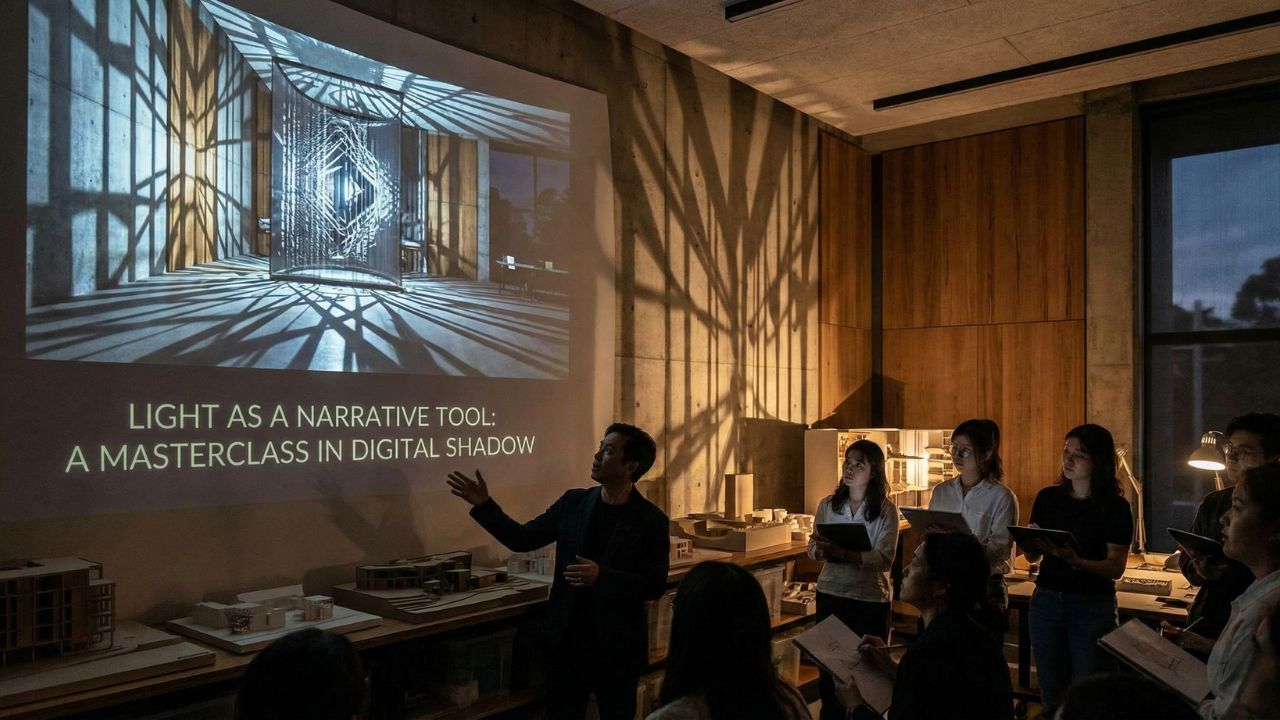
There is a precise moment in a project’s lifecycle that every Principal in London or Dubai recognizes: the first time the sun hits the finished site at 4:00 PM. It is the moment the “spatial narrative” ceases to be an intellectual exercise and becomes a visceral reality. The way a long, raking shadow falls across a fluted stone wall doesn’t just indicate the time of day; it dictates the emotional temperature of the room. It is the difference between a house and a sanctuary.
Yet, for years, our industry has been obsessed with the wrong half of the equation. We have mastered “lighting,” but we have neglected “shadow.” In the “Business of Awe,” shadow is not merely the absence of light; it is the most powerful storytelling tool in the architect’s arsenal. The challenge for 2026 is moving beyond the clinical, over-lit renders of the past and mastering the art of the Digital Shadow.
The Dilemma: The Sterile Brightness of the Static Render
The fundamental failure of traditional architectural visualization is its fear of the dark. Most static renders—the kind that fill the PDFs sent to HNW clients—are optimized for clarity, not for atmosphere. They are “even,” bright, and fundamentally dishonest. By illuminating every corner to prove the design is “there,” we inadvertently strip the space of its soul.
When a presentation lacks the “phenomenology of shadow,” it lacks depth. The client cannot perceive the weight of the materials or the volume of the voids. This creates a “Sensory Flatness” that devalues the design. If a client in a Mayfair boardroom cannot feel the moody, chiaroscuro-inspired transition from a bright atrium to a darkened gallery, they cannot value the intellectual rigor that went into that transition. You are selling a flat image, but they are looking for an immersive experience.
The Analysis: Chiaroscuro in the Age of Code
To reclaim the narrative power of light, we must return to the principles of the masters—from Caravaggio to Kahn—and apply them through the lens of Digital Classicism. This is where Digital Craftsmanship meets the “haptic soul” of architecture.
A Masterclass in Digital Shadow requires an understanding of three core atmospheric principles:
- The “Shadow Gap” and Materiality: Shadow is the only thing that proves texture. Without the microscopic shadows cast by the grain of hand-hewn oak or the rough-hewn edge of a limestone block, a material looks like plastic. High-fidelity digital twins must prioritize “ambient occlusion”—the subtle darkening in the corners and crevices—to trigger the client’s tactile memory.
- Circadian Narrative: Light is a clock. In the elite residential market, you aren’t just selling a room; you are selling a 24-hour cycle of well-being. Using real-time ray tracing, we can now simulate the exact movement of light and shadow across a site’s specific coordinates. Showing a client the “4 PM Shadow” is a more powerful sales tool than showing them the floor plan.
- The Emotional Pivot: Shadow creates “spatial punctuation.” A sudden pool of darkness can act as a psychological reset, preparing the inhabitant for the next “reveal.” Mastering this digital chiaroscuro allows the architect to “direct” the client’s emotional journey through the space long before the first stone is laid.
The Strategy: Designing with the “Off” Switch
For the Principal looking to secure high-value commissions, the strategy must shift from showing the design to simulating the atmosphere.
- The “Shadow-First” Review: In your next internal design review, turn off the artificial “work lights” in your model. See if the architecture still holds its own when only natural, raking light is applied. If the “spatial narrative” disappears in the shadows, the design isn’t strong enough.
- Narrative Lighting Vignettes: Instead of a generic “daylight” render, provide three “Atmospheric Vignettes”: The Morning Threshold, The Midday Zenith, and The Evening Ember. Focus on the shadows.
- The Haptic Proof: Use immersive VR to let the client “stand” in the shadow. Let them experience the cooling effect of the shade and the warmth of the light-play. This provides the “haptic feedback” that closes the gap between aspiration and certainty.
The Bizwity Perspective: The Architecture of Atmosphere
At Bizwity, we believe that the most sophisticated technology is the kind that knows how to handle the dark. Our approach to “Digital Classicism” is centered on the idea that the “soul” of a building lives in its shadows.
By utilizing high-fidelity real-time engines, we help Principals move beyond the “static glass ceiling” of the traditional render. We don’t just help you light your projects; we help you curate the darkness. We allow your clients to experience the “phenomenology of space” through immersive storytelling that respects the tempo of light. In the 2026 market, the firm that masters the Digital Shadow is the firm that truly owns the “Business of Awe.”
Leave A Comment
You must be logged in to post a comment