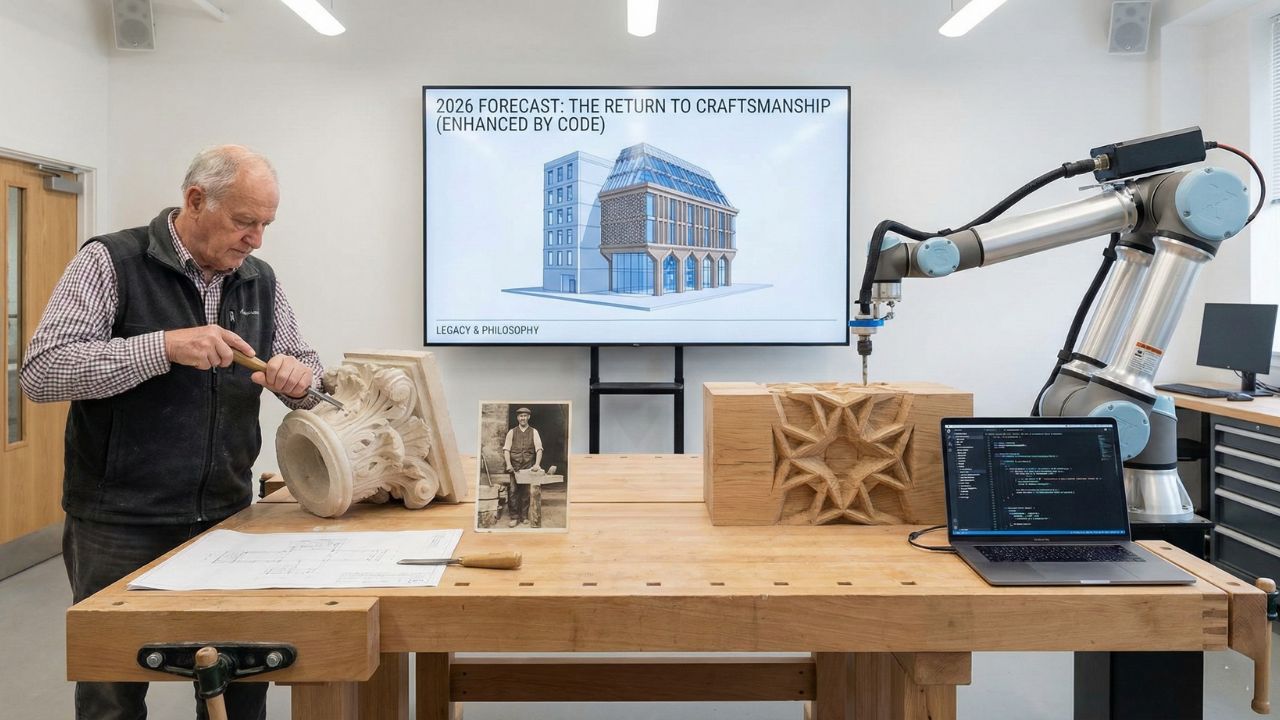
As we enter 2026, the architectural pendulum is swinging back from the hyper-efficient, “cookie-cutter” minimalism of the last decade toward a visceral, haptic renaissance. For the Principals of elite firms in London, Dubai, and Singapore, the forecast is clear: high-net-worth clients are no longer satisfied with “luxury” as a label. They are demanding a return to True Craftsmanship—the kind that possesses a soul, a history, and an unmistakable human touch.
However, this is not a retreat into the past. We are witnessing the rise of a new paradigm: Digital Classicism. It is a movement where the ancient virtues of the artisan are not replaced by code, but rather amplified, protected, and perfected by it.
The Dilemma: The Crisis of the “Soul-less” Surface
In recent years, “digital” has often been synonymous with “clinical.” We have used technology to flatten our processes, resulting in spaces that look flawless in a render but feel emotionally inert in reality. This “Sensory Poverty” has led to a market fatigue where the sophisticated client can spot a “standard” digital output from a mile away.
The dilemma for the modern firm is how to scale excellence without losing the “Founder’s Touch”—the granular obsession with detail that defines a legacy project. To survive 2026, firms must move beyond the “efficiency of the machine” and embrace the “craftsmanship of the algorithm.”
The Analysis: The Three Pillars of 2026 Craftsmanship
The forecast for this year rests on three technological-philosophical pillars:
- Computational Articulation: We are seeing a move away from generic parametricism toward “Computational Craft.” This involves using AI and custom scripts not to design the building, but to articulate the material joints, the fluting of the stone, and the “In-Between” spaces with a level of forensic detail that would be impossible by hand alone.
- The Haptic Twin: The “Digital Twin” has evolved. In 2026, it is no longer just a structural map; it is a sensory prototype. Using real-time engines like Unreal Engine 5.5, we can now simulate the “phenomenology of light” and the exact tactile resistance of a material, allowing the architect to “feel” the craftsmanship before a single stone is cut.
- The Hybrid Artisan: The master mason of 2026 works with a chisel in one hand and a Mixed Reality headset in the other. Code is being used to guide the human hand, ensuring that “Digital Classicism” maintains its material honesty while achieving a geometric complexity that honors the site’s unique “Spatial Narrative.”
The Bizwity Perspective: Engineering the “Founder’s Touch”
At Bizwity, we believe that technology’s greatest purpose is to make the architect’s intuition visible. Our role in the 2026 landscape is to act as the “Digital Stewardship” layer for elite firms.
We help you turn your “Intellectual IP”—your unique design DNA—into high-fidelity digital assets that can be scaled without losing their “haptic soul.” By utilizing our Lifestyle Visualist approach, we ensure that your digital content doesn’t just show a building; it premieres a vision. We bridge the gap between the raw power of code and the timeless elegance of craft, ensuring that your firm remains the inevitable choice for clients who demand nothing less than “Foundational Awe.”
Leave A Comment
You must be logged in to post a comment