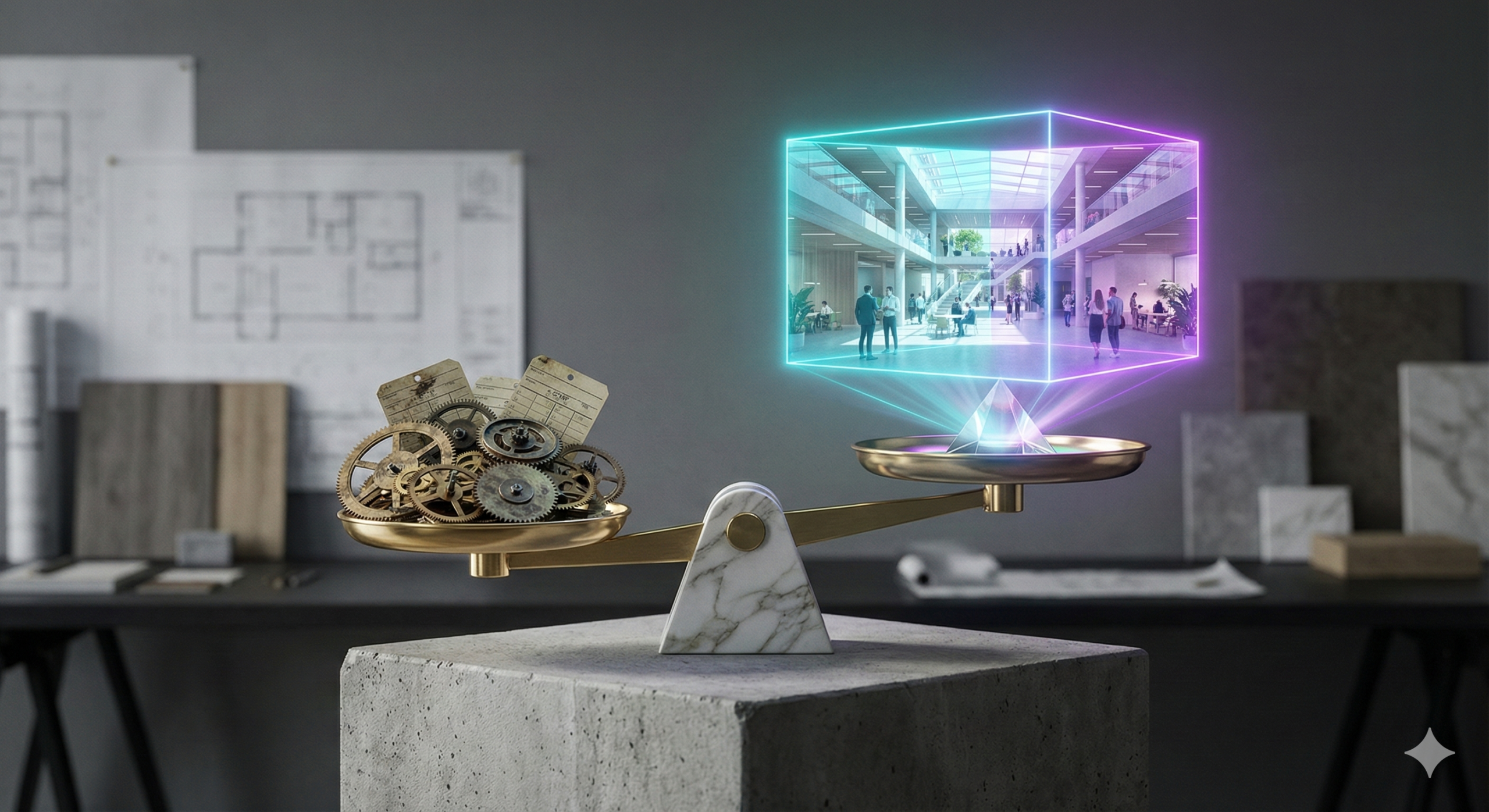
There is an inherent, almost insulting disconnect that occurs at the end of a landmark project. You have just delivered a sprawling penthouse overlooking Hyde Park or a culturally significant majlis in Dubai—spaces defined by exquisite materiality and complex structural narrative. Yet, the final conversation with the client is reduced to a pecuniary dissection of timesheets and hourly rates.
It is the industry’s oldest wound: the misalignment between the immense, enduring value of high-end architectural design and the archaic, industrial-era method we use to price it. For the Founders of elite firms, continuing to shackle your intellectual capital to the billable hour is not just bad business; it is a fundamental devaluation of your craft. As we look toward 2026, the market for ultra-prime design demands a radically different financial model—one based on the “experiential asset” you create, not the time it took you to conceive it.
The Dilemma: The Commoditization of Genius
The hourly billing model is a relic of a time when architecture was viewed primarily as a technical service rather than the creation of high-value intellectual property. When a firm bills by the hour, it implicitly tells the client: “We are selling you our labor.” In the luxury sector, this is a catastrophic positioning error.
Labor is a commodity; vision is scarce.
The dilemma facing sophisticated Principals today is that efficiency is punished. If your senior team, leveraging decades of experience and cutting-edge “Digital Craftsmanship,” solves a complex site constraint in four hours instead of forty, the hourly model dictates you should be paid less for that brilliance. This structure incentivizes bloated processes over elegant solutions and aligns your firm with contractors rather than consultants. In the boardrooms of Mayfair and DIFC, your clients do not buy hours; they buy certainty, status, and awe.
The Analysis: The Asymmetric Value Proposition
The shift required for 2026 is recognizing the asymmetry between your input costs and the client’s outcome value. A well-executed architectural intervention does not just house a client; it significantly enhances their quality of life, optimizes their business operations, or vastly increases the asset value of their property portfolio.
In the current experiential economy, architecture is the ultimate luxury good. The “phenomenology of space”—how a room feels, the way light dictates mood, the tactile response of materials—is where the true value lies. These are intangible deliverables that cannot be measured by a stopwatch.
When firms stick to hourly billing, they fail to capture the value of this “experiential equity.” They remain trapped in a transactional relationship, constantly defending their time, rather than evolving into a strategic partnership focused on maximizing the project’s potential.
The Strategy: Decoupling Time from Revenue
Transitioning to an experience-based pricing model is to move from being a vendor to being a partner. It requires confidence and a restructuring of how you articulate value.
- Productize the “Visioning Phase”: Stop giving away your best ideas in free pitch meetings. Create a standalone, fixed-fee “Visioning Package.” This is a high-value, low-risk entry point for the client where you deliver initial concepts, site analysis, and strategic direction. It establishes authority and gets paid for high-level intellectual property upfront.
- Value-Based Phasing: Instead of generic RIBA stages linked to hours, define phases by experiential outcomes. A “Spatial Narrative Definition” phase carries a higher fixed value than a “Construction Documentation” phase, reflecting the higher density of creative intellect required.
- The “Certainty Premium”: High-net-worth clients will pay a premium for reduced risk. Frame fixed-fee structures not as a cost savings, but as a guarantee of delivery without the volatility of hourly overruns. You are selling price certainty alongside design excellence.
The Bizwity Perspective: Immersive Validation
The most significant barrier to value-based pricing has always been the client’s inability to visualize the outcome before signing the contract. This is where “Digital Classicism” becomes a financial tool.
At Bizwity, we see immersive technology as the validator of high fees. When you can place a client inside a hyper-realistic digital twin of their future project during the proposal phase, the conversation shifts immediately. They are no longer buying promises; they are experiencing the future reality.
Immersive portfolios and VR walkthroughs provide the “haptic proof” of your concept. When a client has already emotionally connected with the space through immersion, the fee becomes secondary to acquiring that experience. Technology allows you to front-load the “awe,” making the transition from hourly haggling to value-based partnership not only possible but inevitable.
Leave A Comment
You must be logged in to post a comment