In the high-stakes galleries of London’s property markets and the sleek presentation suites of Dubai, there is a common, fatal error: the “Everything, Everywhere, All at Once” pitch. Architects, fueled by a justifiable pride in their rigor, attempt to sell the client on the entire building—the structural grid, the HVAC efficiency, the basement car lift, and the rooftop garden—all with equal weight.
But high-net-worth clients do not fall in love with a structural grid. They fall in love with a moment.
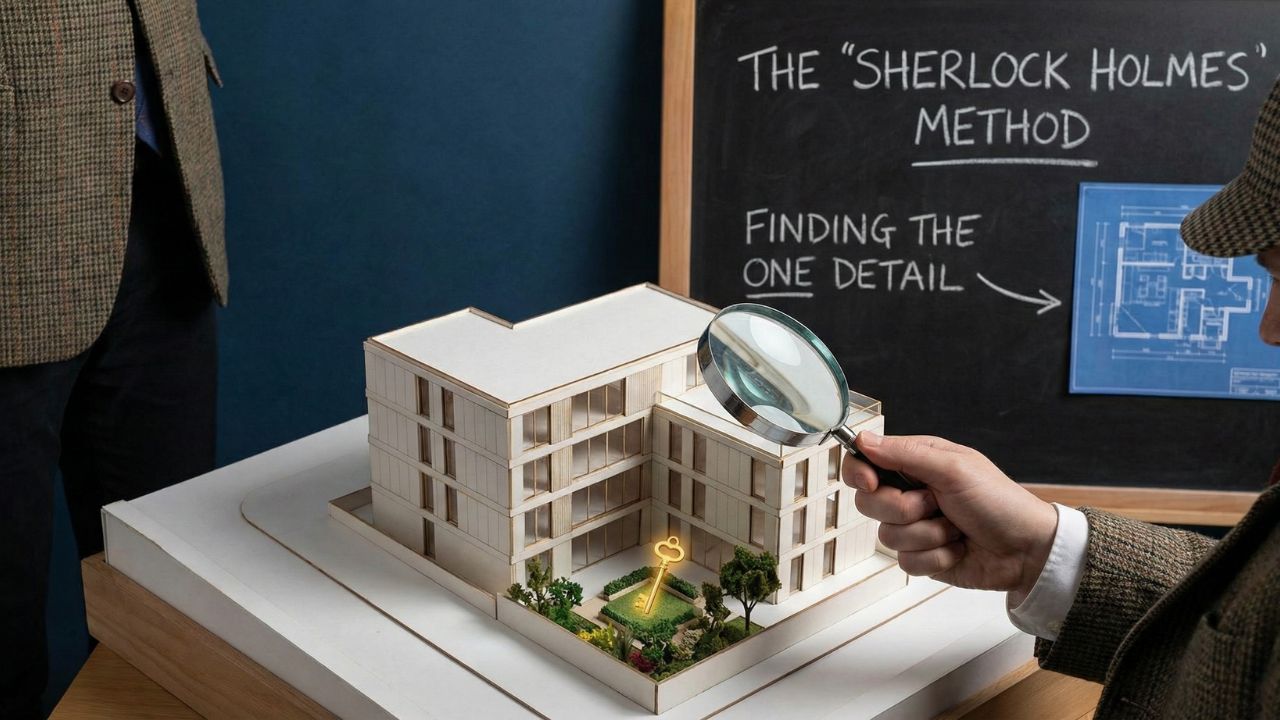
To win the most prestigious commissions in 2026, the elite Principal must adopt what we call the “Sherlock Holmes” Method. It is the art of forensic design—the ability to identify the one singular, obsessive detail that encapsulates the entire “spatial narrative” and makes the project feel inevitable. In the “Business of Awe,” the smallest detail is often your biggest closer.
The Dilemma: The Curse of the Generalist Pitch
The dilemma for the sophisticated designer is that your work is inherently complex, yet your client’s attention is a scarce, expensive resource. When you present forty slides of varying importance, you are asking the client to do the editorial work of finding the “soul” of the project themselves.
If they can’t find it, they default to looking at the price.
A “generalist” pitch creates a lack of emotional “haptic feedback.” It feels like a commodity. Without a focal point—a singular “artifact of design”—the project lacks a hook for the client’s memory. They leave the meeting remembering a “nice house,” rather than the “house with the monolithic bronze door that sounds like a vault when it closes.” Without the detail, you lack the legend.
The Analysis: Forensic Architecture and the Power of the “Parti”
The “Sherlock Holmes” Method is based on the classical concept of the Parti—the “big idea” of a building—but it focuses that idea into a microscopic lens. It is about finding the one “Design DNA” strand that proves the brilliance of the whole.
In the realm of Digital Classicism, this method relies on three forensic steps:
- The Observational Audit: Before drawing a line, observe the client’s “unspoken rituals.” Do they have a specific way they handle their watch collection? Is there a particular way they prefer to watch the sunrise? Sherlock Holmes famously observed the wear on a watch to understand its owner; you must observe the “phenomenology” of their life to find the detail.
- The Artifact of Awe: Once you identify the ritual, you design the “Artifact.” This might be a bespoke staircase handrail that perfectly matches the ergonomic grip of the owner, or a skylight positioned so that on the client’s birthday, the sun hits a specific piece of art. This isn’t just a feature; it’s a narrative proof.
- The Scale Shift: In your presentation, you reverse the traditional order. You don’t start with the site plan; you start with the detail. By showing the client that you have solved for their most intimate, micro-moment, you subconsciously signal that you have also mastered the macro-complexity of the entire build.
The Strategy: Engineering the “Hero Detail”
To implement this method, you must shift your design and presentation workflow toward “Narrative Density.”
- Lead with the Micro: In your next proposal, dedicate 30% of the time to a single, high-fidelity “Experience Vignette.” If it’s a penthouse, don’t just show the living room; show the custom-carved stone plinth where they will place their morning espresso.
- The “Haptic Proxy”: Use immersive tech to let the client “interact” with the hero detail. Let them virtually feel the weight of the bespoke handle or see the light catch the grain of the rare marble.
- The ROI of Obsession: Frame the detail not as an “extra,” but as the “Asset Value” of the firm’s intellectual capital. Explain the engineering and “digital craftsmanship” required to make that one moment happen. This justifies your fees by proving your level of care.
The Bizwity Perspective: Immersive Forensic Storytelling
At Bizwity, we recognize that the “Sherlock Holmes” Method requires a level of visual fidelity that traditional renders cannot provide. You cannot sell a “Hero Detail” if the digital representation looks like a plastic toy.
We help firms use immersive technology to perform “Spatial Forensic” presentations. We allow you to take the client from a 1:1,000 site view down to a 1:1 material detail in a single, fluid motion. By focusing the power of “Digital Classicism” on the singular moments that matter most to your client, we turn your presentation into a narrative of inevitability. We don’t just show them a building; we show them that you have noticed the things no one else has. And that, more than anything, is what closes the deal.
Leave A Comment
You must be logged in to post a comment