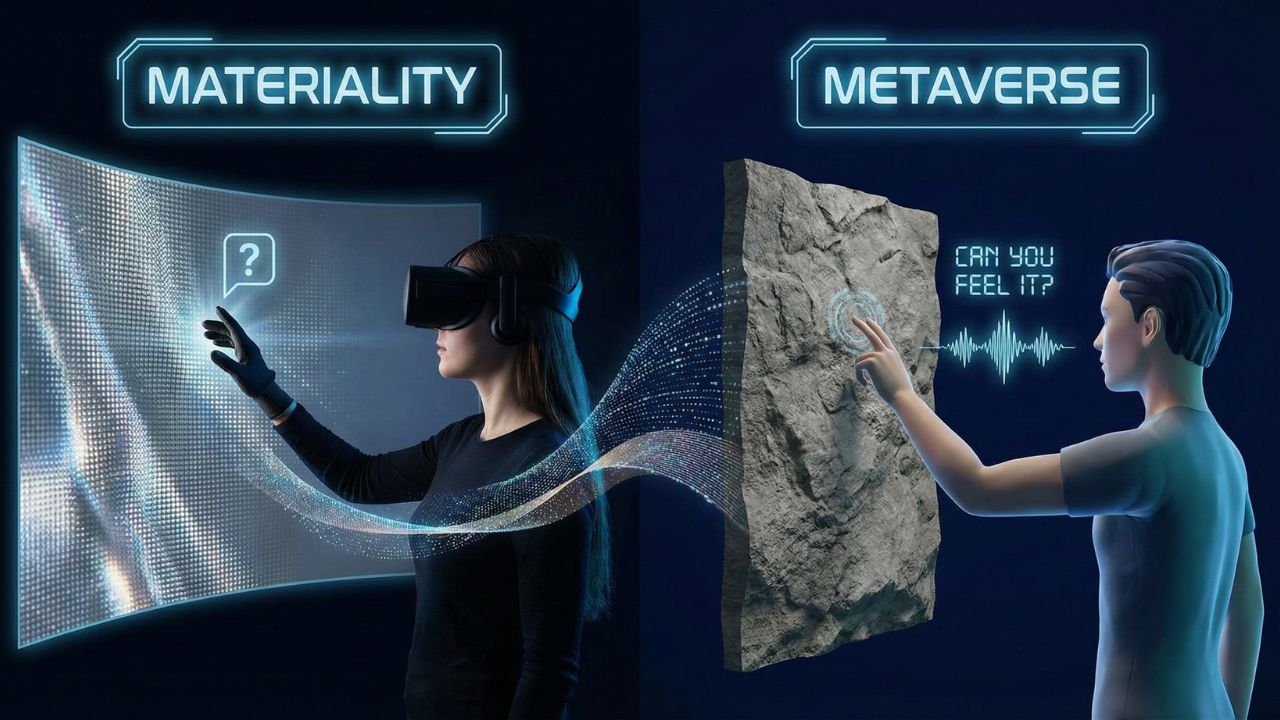
Close your eyes and imagine running your hand over a slab of cold, honed Pietra Gray marble. You feel the microscopic fissures, the slight temperature drop where the stone meets the air, and the subtle, gritty resistance of a natural finish. Now, imagine trying to convey that exact visceral sensation to a client in a Dubai boardroom using a flat, 2D render on a MacBook screen.
The gap between those two experiences is where the most ambitious projects often falter. For the Principal of an elite firm, materiality isn’t just a specification; it is the “haptic soul” of the building. Yet, as we move toward the metaverse and increasingly digital workflows, we face a profound dilemma: in a world of pixels and polygons, can we ever truly communicate the feeling of a physical surface?
The Dilemma: The Sensory Divorce of the Digital Portfolio
The traditional architectural presentation has long suffered from a “sensory divorce.” We spend months sourcing the perfect hand-charred cedar or the exact patina of oxidized bronze, only to have that effort flattened into a static image. Standard CGI, no matter how “photorealistic,” often feels clinical. It lacks what we call the “Integrity of Imperfection”—the tiny, chaotic details that tell the human brain a material is real.
For a high-net-worth client, luxury is experienced through the senses. When a digital presentation fails to evoke a tactile response, the client remains emotionally detached. They are looking at a picture of a room, rather than feeling the atmosphere of a home. This failure of medium forces the architect to rely on physical material boards—cumbersome, expensive, and often impossible to transport for global projects. If the client can’t “feel” the materiality, they cannot fully commit to the vision.
The Analysis: Digital Craftsmanship and the Physics of Awe
The solution is not to abandon the digital, but to master Digital Craftsmanship. In the philosophy of Digital Classicism, materiality in the metaverse is not about “looking” real; it is about behaving real.
To bridge the tactile gap, elite firms are shifting from static visualization to high-fidelity “Physical Simulations.” This involves three key pillars of digital materiality:
- Light-Material Interaction (LMI): True materiality is defined by how light behaves. In 2026, using real-time ray tracing, we can simulate “sub-surface scattering”—the way light penetrates a piece of translucent onyx or the way it catches the weave of a heavy linen wallcovering. When the light moves naturally, the brain begins to “feel” the texture.
- The “Haptic Proxy”: While we cannot yet reach through a screen to touch stone, we can use “visual haptics.” By rendering the microscopic “noise” of a material—the dust in a crevice or the slight wear on a leather armrest—we trigger the viewer’s tactile memory. We aren’t showing them a texture; we are reminding them of a feeling they already know.
- Atmospheric Density: Materiality is never isolated. A stone floor feels different in the humid air of a London conservatory than it does in the dry heat of a Dubai villa. Digital Classicism uses immersive tech to simulate the atmosphere around the material, providing the context that makes the texture feel grounded in reality.
The Strategy: Moving Beyond the Material Board
To leverage digital materiality for business growth, Principals must shift their strategy from display to immersion.
- The “Material Narrative” Pitch: Instead of showing a grid of materials, tell the story of one. Use a high-fidelity “Micro-Vignette” to show how a specific wood grain evolves under different lighting conditions throughout the day.
- Virtual Sampling: Replace the physical material board with a “Digital Twin” of the material library. Allow clients to swap out textures in a VR environment in real-time. This doesn’t just save time; it empowers the client to participate in the “phenomenology of space.”
- The Specifier’s Authority: Position your use of high-tech material simulation as a form of risk mitigation. Prove to the client that you have tested every material interaction in a digital environment before a single order is placed.
The Bizwity Perspective: Restoring the Human Touch
At Bizwity, we believe that the “spatial narrative” is incomplete without a sensory connection. Our approach to “Digital Classicism” is designed to ensure that the technology never feels like a barrier between the architect and the artisan.
By utilizing advanced game-engine technology and immersive storytelling, we help firms create digital experiences where the materiality is so dense, so present, that the client forgets they are looking at a screen. We don’t just build virtual models; we build “Experiential Prototypes.” In the Business of Awe, the firm that can make a client “feel” a digital texture is the firm that creates the most compelling reason to build the physical reality.
Leave A Comment
You must be logged in to post a comment