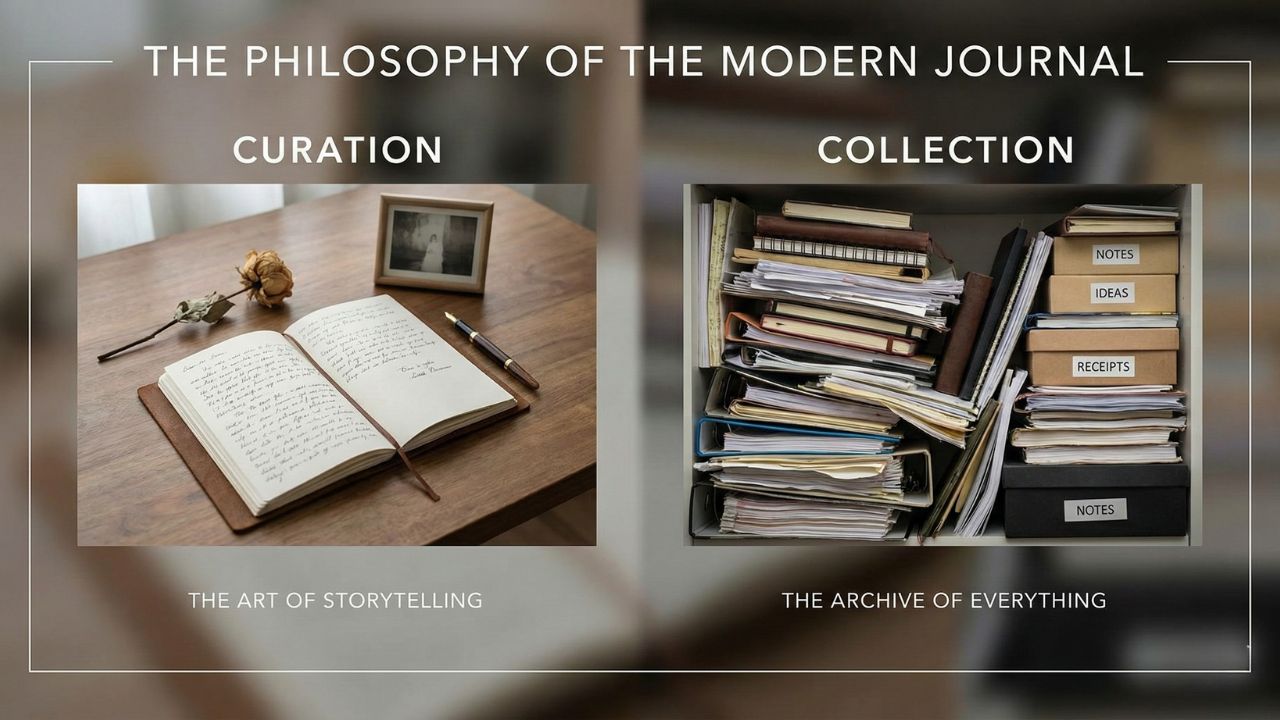
There is a specific, quiet exhaustion that settles over a Principal during the final stages of a website redesign or the assembly of a new monograph. You are surrounded by a decade of high-fidelity imagery: the heritage restoration in Kensington, the brutalist retreat in the Al Marmoom desert, the minimalist penthouse in Tribeca. Each project represents thousands of hours of “spatial narrative” and meticulous “digital craftsmanship.” Yet, when viewed together in a grid, the individual soul of each work begins to blur.
You find yourself looking at a collection, when what your brand truly requires is a curation.
In the “Business of Awe,” the difference between these two states is the difference between being an archivist and being a visionary. For the elite firms of London and Dubai, the modern portfolio must transcend the role of a digital filing cabinet. It must become a “Living Journal”—a curated intellectual argument that proves your inevitable value to the world’s most sophisticated clients.
The Dilemma: The Gravity of the “More” Trap
The dilemma for the successful Founder is the instinct to hoard. We believe, perhaps subconsciously, that a massive collection of past work serves as a shield against risk. We think that showing everything proves we can do anything.
However, in the hyper-saturated markets of 2026, volume is a commodity. When a high-net-worth client or a royal developer lands on a portfolio that feels like a “collection,” they experience cognitive fatigue. Static websites and PDF decks that attempt to show every facet of a firm’s history often end up saying nothing at all. They lack the “phenomenology of space” because they prioritize quantity over the emotional resonance of a singular, curated message. You aren’t inviting the client into a story; you are asking them to sort through your laundry.
The Analysis: The Editor as Architect
Curation is an act of violence against the mediocre. To curate is to select, to frame, and—most importantly—to exclude.
In the philosophy of Digital Classicism, the Modern Journal serves as the bridge between your past rigor and your future potential. A collection is a record of what you did; a curation is a manifesto of what you believe.
- The Narrative Filter: A curation is built around a “spatial narrative.” Instead of showing five different kitchens, you show one specific transition from a light-filled breakfast room to a moody, subterranean cellar. You are selling the logic of the transition, not the specifications of the cabinetry.
- Intellectual IP over Imagery: A “collection” focuses on the finished photo. A “curation” focuses on the intellectual capital—the sketches, the site constraints, and the “haptic feedback” of the design process. This positions the Principal as a consultant of “experiential luxury,” rather than a vendor of blueprints.
- The Aura of Scarcity: By curating your output down to the absolute pinnacle of your work, you create an aura of scarcity. You signal to the London and Dubai markets that your time is a limited resource and your vision is reserved for those who value the “Business of Awe” over mere square footage.
The Strategy: Pruning for Growth
To transition from a “collection” to a “curated journal,” the Principal must adopt an editorial mindset.
- Kill Your Darlings: Remove any project from your public-facing journal that does not align with the type of project you want to win tomorrow. If you want to design museums but your portfolio is 80% mid-market residential, you are trapped in your own collection.
- Contextualize the “Awe”: Every project entry must lead with a provocative observation about the “phenomenology” of that specific space. Don’t tell the client what it is; tell them why it matters.
- The 70/30 Rule: Dedicate 70% of your digital presence to your “curated peaks”—the work that defines your legacy. Use the remaining 30% for “Process Journals”—the behind-the-scenes look at your digital craftsmanship and VR explorations.
The Bizwity Perspective: The Immersive Curator
At Bizwity, we recognize that the greatest challenge for a busy Principal is finding the time to edit. You are often too close to the work to see the narrative threads that connect your finest moments.
We view immersive technology as the ultimate tool for curation. By utilizing high-fidelity digital twins and real-time storytelling, we help firms move away from “collecting” renders and toward “curating” experiences. We allow you to take a client through a singular, perfected “spatial narrative” that encapsulates your entire philosophy in minutes.
A “Bizwity Journal” isn’t a website; it’s a high-end, immersive concierge that does the selling for you. It ensures that while you are focused on design excellence, your digital presence is performing the “Silent Sale,” positioning you not just as an architect, but as the inevitable curator of your client’s future.
Leave A Comment
You must be logged in to post a comment