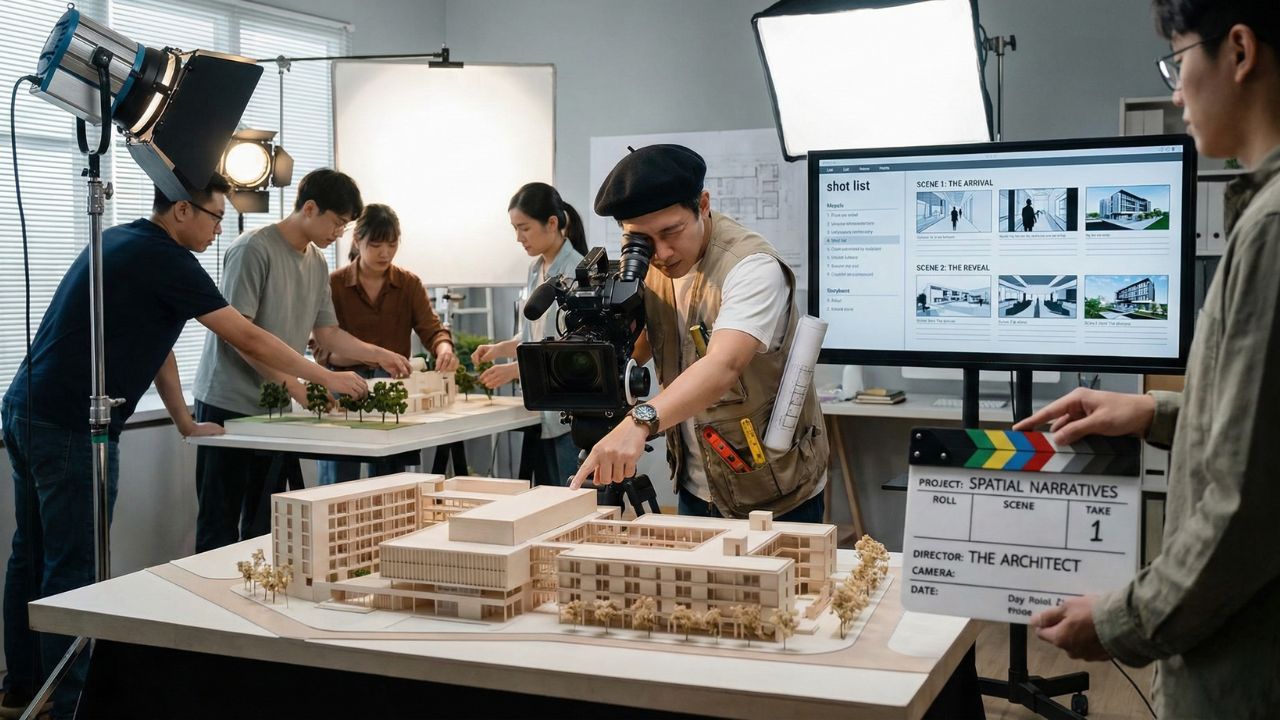
Consider the opening sequence of a masterpiece in cinema. There is no dialogue, yet you understand the stakes, the atmosphere, and the soul of the story through the deliberate movement of the lens—the way light catches a fraying curtain, the rhythm of a character’s footsteps echoing in a hall, the slow, agonizing reveal of a horizon.
Now, consider the way most elite architectural firms present a £20 million project. They offer a static site plan, a few disjointed renders, and perhaps a material board. The “story” is fragmented, trapped in the white space between slides. The client is asked to be the editor, the director, and the audience all at once. For the Principal in London or Dubai, this is a profound missed opportunity. To sell the “Business of Awe,” you must stop thinking in floor plans and start thinking in frames. You must think like a film director.
The Dilemma: The Static Perspective
The fundamental challenge of high-end design is that while a building is a three-dimensional object, the experience of it is a four-dimensional journey. It is a sequence of events unfolding over time.
Traditional architectural education trains us in the “God’s-eye view”—the plan and the section. These are essential for construction, but they are useless for empathy. When we present our work through static media, we are offering the client the script but denying them the movie. This “Static Perspective” fails to communicate the phenomenology of space—the emotional transition from a grand, public entrance to the haptic, intimate sanctuary of a private study. If the client cannot perceive the narrative arc of your design, they cannot fully value your genius. They see a structure; they don’t see a life.
The Analysis: Mise-en-scène and Spatial Montage
In cinema, the term mise-en-scène refers to everything captured within the frame: the arrangement of actors, the lighting, the decor, and the textures. In Digital Classicism, the architect uses these same principles to engineer experiential luxury.
- The Choreographed Sequence (The Montage): A film director understands that a close-up followed by a wide shot creates a specific emotional impact. Architects must apply this “spatial montage.” How does the compression of a timber-lined foyer enhance the expansion of the marble-clad atrium? By thinking like a director, you prioritize the pacing of the reveal over the static beauty of the room.
- The Lighting Narrative: Light is the director’s most potent tool for directing the eye and setting the mood. In architectural storytelling, we must use light not just for visibility, but for “spatial punctuation.” We use high-fidelity digital twins to simulate the “cinematic glow” of golden hour in a specific courtyard, proving to the client that we have mastered the atmosphere of their future reality.
- Haptic Pacing: A director controls the speed of a scene. An architect controls the speed of a human. By designing “visual anchors” or tactile textures at key transition points, you are directing the client’s movements. This is “Digital Craftsmanship” at its most sophisticated—using technology to ensure the human experience is choreographed to perfection.
The Strategy: From Presentation to Premiere
To shift your practice toward a cinematic model, you must treat your client meetings as “premieres” rather than reviews.
- Script the Journey: Before the meeting, write a one-page narrative of the “walkthrough.” Describe the scents, the sounds, and the emotional shifts. This establishes the “Spatial Narrative” before a single image is shown.
- Leverage Real-Time Immersion: Abandon the linear PDF. Use real-time engines to allow the client to “direct” their own experience. Let them move through the space, change the time of day, and test material interactions. This grants them a sense of “pre-occupancy” that no static image can provide.
- Focus on the “Opening Shot”: The first ten seconds of an immersive experience are the most critical. Ensure your digital entry point captures the “soul” of the project immediately. Use atmospheric density and realistic textures to trigger an immediate, visceral “Awe.”
The Bizwity Perspective: The Director’s Monitor
At Bizwity, we view our immersive platforms as the architect’s “director’s monitor.” We provide the tools that allow you to step inside your script and see how the movie is playing out before the first stone is laid.
By bridging the gap between classical design philosophy and cinematic digital storytelling, we help Principals communicate the intangible. We don’t just help you show a project; we help you premiere a vision. In the “Business of Awe,” the firm that can direct the client’s emotional journey is the firm that inevitably wins the commission.
Leave A Comment
You must be logged in to post a comment