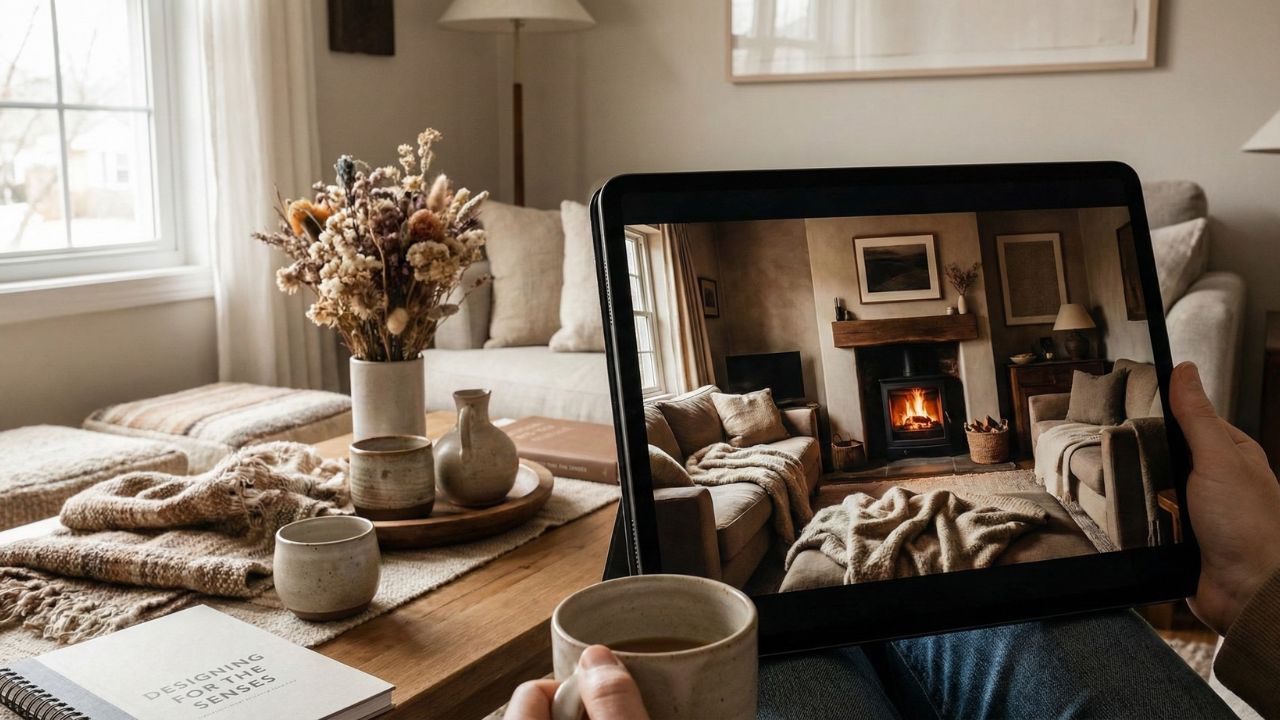
An interior is not a collection of objects; it is a weight of air. It is the specific, silent pressure of a heavy wool curtain against a draft, the scent of waxed oak in a heritage library, and the cooling touch of a limestone floor on a mid-August afternoon in Dubai. These are the sensory anchors of “experiential luxury”—the visceral cues that tell a client they are home.
The dilemma for the modern interior designer is that our primary medium of communication has become a flat, glass rectangle. In the transition from the studio to the screen, the “atmosphere” of a project often evaporates. We are presenting high-fidelity images that are technically perfect yet haptically hollow. For the Principal of an elite firm, the challenge of 2026 is bridging this sensory void: how do you make a client feel the atmosphere of a room before the first sample is even ordered?
The Analysis: The Visual-Tactile Gap
The fundamental crisis of digital interior presentation is the “Visual-Tactile Gap.” Traditional renders prioritize geometry and color, but they ignore the phenomenology of space—the study of how we experience our environment through our bodies, not just our eyes.
When a client looks at a standard render, their brain processes it as “visual data.” They see a sofa; they don’t feel the “haptic feedback” of the mohair velvet. They see a window; they don’t perceive the specific quality of light as it filters through a bronze mesh screen. This sensory disconnect forces the client to remain a spectator rather than a participant. In the “Business of Awe,” if the client remains a spectator, they are more likely to haggle over costs. If they become a participant, they are invested in the vision.
To solve this, we must shift our digital strategy from “showing” to “simulating.” We must embrace Digital Classicism—using the highest forms of technology to honor the most ancient of human senses.
The Strategy: Engineering Sensory Proxies
Conveying atmosphere through a screen requires a move toward “Digital Craftsmanship.” You are no longer just an interior designer; you are a sensory orchestrator.
- Light as a Material, Not an Effect: In your digital presentations, treat light as a physical presence. Use real-time ray tracing to simulate “volumetric lighting”—the way dust motes dance in a sunbeam or how light “bleeds” around a soft edge. This creates “atmospheric density,” signaling to the client’s subconscious that the space has depth and air.
- Materiality as Behavior: Stop presenting static textures. In an immersive or real-time environment, show how materials behave. Show how a silk wallpaper shifts its sheen as the viewer moves, or how a hand-planed wood floor reflects a low winter sun. When materials react to their environment, the brain perceives them as “true,” triggering a tactile memory.
- The Acoustic Narrative: Atmosphere is 50% sound. When presenting a digital twin or an immersive walkthrough, integrate “Spatial Audio.” The slight echo of a stone-clad hallway transitioning into the dampened, hushed tones of a carpeted master suite provides a powerful sensory cue that reinforces the spatial narrative.
The Bizwity Perspective: The Immersion of Empathy
At Bizwity, we understand that the greatest barrier to design excellence is the “empathy gap” between the architect’s imagination and the client’s perception.
We view immersive technology not as a digital replacement for the physical world, but as its most sophisticated proxy. By utilizing high-fidelity real-time engines, we allow Principals to place their clients inside the “atmosphere” long before the site is even cleared. When a client can experience the “haptic soul” of an interior through an immersive journey—hearing the silence, seeing the light-play, and perceiving the material weight—the technology disappears. What remains is a profound human connection to the space. In the 2026 market, the firm that can deliver atmosphere through a screen is the firm that commands the most lucrative commissions.
Leave A Comment
You must be logged in to post a comment