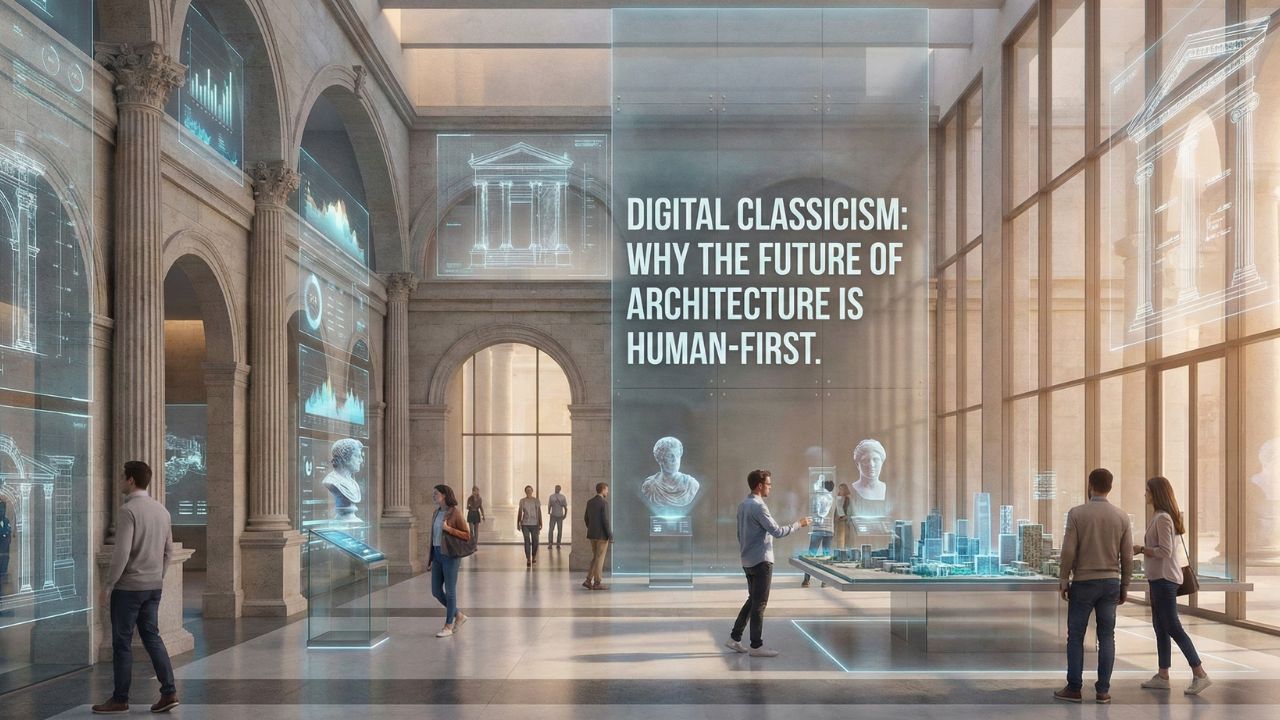
Architecture, at its apex, is not an intellectual exercise; it is a physiological event. It is the sudden drop in temperature when you enter a stone vestibule in Rome, the acoustic embrace of a timber-framed library in Kyoto, or the way light tracks across a lime plaster wall in a contemporary desert villa. These moments of “haptic resonance” are why we do what we do. They are the soul of the craft, the enduring legacy that outlives the architect.
Yet, a dangerous schism has opened in the highest echelons of our profession. We have embraced a digital toolset of unprecedented power—from generative AI to hyper-complex BIM protocols—but in doing so, we have largely anaesthetized the presentation of our work. We are producing photorealistic imagery that is technically flawless yet emotionally inert.
The dilemma for the modern Principal in London or Dubai is clear: our tools have never been sharper, but our ability to convey the phenomenology of space—the very human essence of dwelling—is being blunted by the cold precision of code. We are data-rich, but feeling-poor.
The Analysis: Defining Digital Classicism
To reclaim the soul of design without abandoning the advantages of modernity, the industry must pivot toward a new paradigm: Digital Classicism.
Do not mistake this for an aesthetic nostalgia for cornices and columns. Rather, it is a philosophical retrieval of classical values—human proportion, material honesty, and the primacy of the inhabitant’s experience—applied through the lens of advanced technology. It is a rejection of the sterile “render farm” aesthetic in favor of a warmer, more tactile digital reality.
Digital Classicism rests on three pillars:
- The Integrity of Imperfection: A standard CGI render is usually sterile because it lacks the chaotic patina of reality. True luxury has grain. Digital Classicism uses tools like real-time ray tracing in Unreal Engine 5 not to achieve clinical perfection, but to reintroduce the “flaw” of authentic materials—the slight warp of hand-hewn oak, the calcification on aged bronze. It is digital craftsmanship dedicated to replicating the analog soul.
- Proportion over Parametrics: We have become seduced by forms that are mathematically possible but humanly alienating. Digital Classicism uses VR and immersive spaces to rigorously test design against the Vitruvian measure of the human body. It uses tech to ensure that a space feels right, not just that it stands up.
- The Slow Reveal: In an era of instant digital gratification, classical architecture understands pacing. Digital Classicism uses immersive storytelling to control the sequence of arrival and discovery within a project, allowing the client to experience the unfolding “spatial narrative” exactly as the architect intended, rather than clicking randomly through a static gallery.
The Bizwity Perspective: Technology as an Empathy Engine
At Bizwity, we argue that the ultimate role of technology is to make architecture more human, not less. If your technology stack is distancing you from the visceral reality of your materials and your clients’ emotions, it is failing.
We view immersive platforms not as mere visualization tools, but as empathy engines. The power of Digital Classicism is that it uses sophisticated code to make the technology disappear. When a client steps into a high-fidelity, immersive environment that honors material integrity and human scale, the abstraction of the blueprint dissolves. They are no longer judging geometry; they are experiencing atmosphere.
The future of elite architecture does not belong to the firms with the fastest computers or the most complex algorithms. It belongs to the firms that master this essential paradox: using the most advanced digital tools to facilitate the most profoundly human experiences.
Leave A Comment
You must be logged in to post a comment