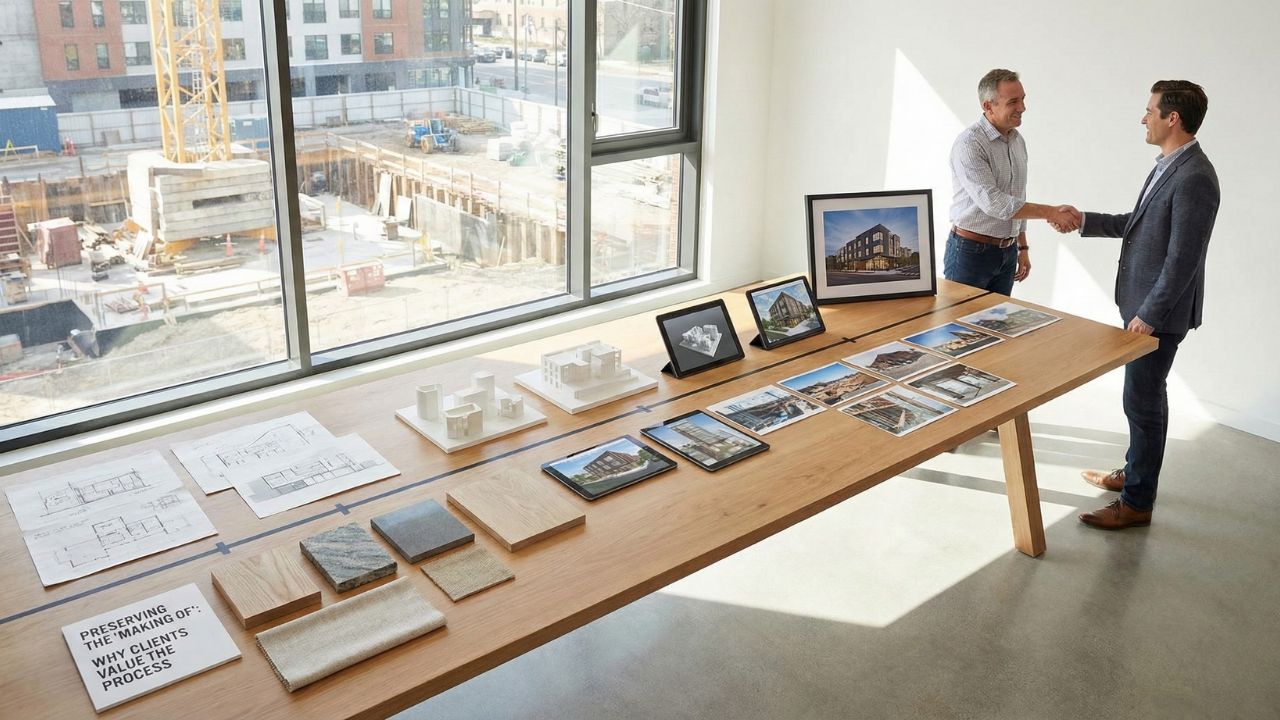
In the world of ultra-high-net-worth (UHNW) commissions, a finished building is rarely just a physical asset; it is a trophy of intellectual and creative endurance. For the clients of elite firms in Mayfair, the Cotswolds, or Dubai’s Jumeirah, the luxury isn’t found only in the final grain of the marble, but in the provenance of the idea.
They want to know how the “spatial narrative” was born. They want to see the friction, the iterations, and the “digital craftsmanship” that led to the “foundational awe” of the final reveal. In 2026, the firms that secure the most prestigious legacies are those that understand that the “Making of” is an asset as valuable as the architecture itself.
The Dilemma: The “Black Box” of Design
Too often, the architectural process is treated as a “black box.” The client sees the initial visionary sketch and the final, polished reality, but the middle—the months of forensic material testing, the shadow studies, and the structural debates—is lost to the archives.
When you hide the process, you inadvertently commoditize the result. If a client doesn’t see the rigor, they struggle to justify the premium. They are left with a finished product, but they are robbed of the narrative of creation. In an era where AI can generate a “perfect” image in seconds, the human effort, the “Founder’s Touch,” and the messy, brilliant evolution of a project are what provide the true “Return on Emotion.”
The Analysis: Process as the Ultimate Proof of Craft
In the philosophy of Digital Classicism, the process is not a byproduct; it is the Digital Provenance. It is the evidence of “haptic soul” in a digital world.
- The Psychological Anchor: Seeing the evolution of a design allows the client to build a psychological bond with the building before the first stone is laid. It transforms them from a “buyer” into a “patron.”
- The Validation of Fees: When a client sees the level of “digital stewardship” required to simulate the raking light of a specific courtyard across four seasons, the high-end fee ceases to be a number and becomes a reflection of labor and expertise.
- Legacy Documentation: A building will change over time, but the “making of” is a fixed point in history. Capturing the process provides the client with a legacy document they can share with their peers and pass down through generations.
The Strategy: Architecting the “Process Journal”
To turn your process into a sales and legacy tool, you must move beyond the casual site photo. You must curate the “making of” with the same rigor as the “final reveal.”
- The Iterative Archive: Use your Digital Twin not just for the final presentation, but as a time-capsule. Archive the key “forks in the road”—the material choices that were rejected and why. This demonstrates a level of forensic care that is the hallmark of a master.
- Cinematic Site Diaries: Replace the grainy phone photo with “Lifestyle Visualist” captures. Document the master mason at work or the Principal sketching in a raw concrete shell. These are the “human-first” moments that anchor the technology.
- The “Behind the Scenes” Premiere: Treat your milestone reviews as “Making Of” screenings. Use immersive technology to show the client the why behind a complex junction or a lighting decision. Let them stand in the digital void before the solids are finalized.
The Bizwity Perspective: Preserving the Soul of Craft
At Bizwity, we believe that the most powerful marketing is transparency. We help elite firms utilize AI and immersive technology to capture the “haptic soul” of their work as it happens.
Through our Digital Stewardship framework, we ensure that your intellectual IP—the sketches, the VR walkthroughs, and the material trials—are preserved as a high-fidelity “Digital Journal.” We turn your process into an “Immersive Narrative” that builds trust and reinforces your authority. We don’t just help you deliver a building; we help you curate a legend.
Leave A Comment
You must be logged in to post a comment