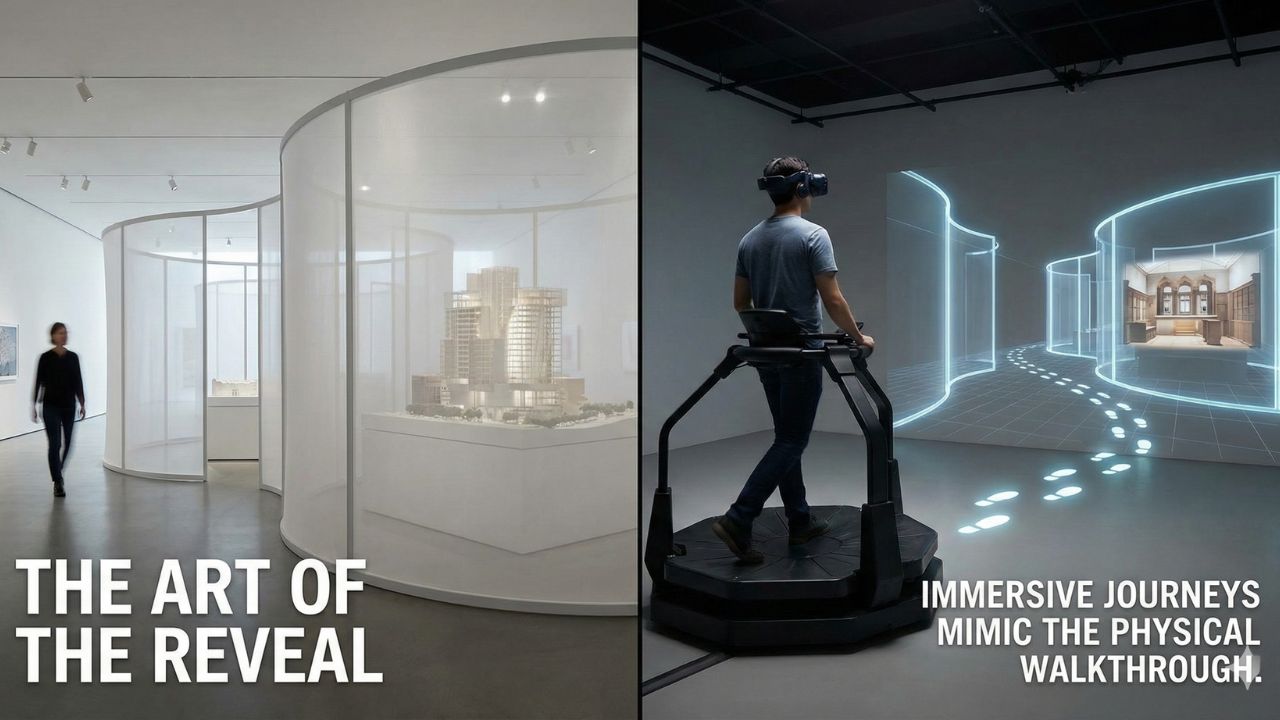
There is a precise sequence of events that occurs when a guest enters a masterfully designed space—be it a brutalist villa in the Emirates or a heritage townhouse in Belgravia. It is the choreographed transition from the street to the sanctuary. It begins with the weight of the entry door, followed by a compressed hallway that suddenly explodes into a double-height atrium, finally settling into the soft, haptic embrace of a private library.
In the trade, we call this the “The Reveal.”
For the Principals of elite firms, the “Reveal” is the climax of the spatial narrative. It is where the intellectual rigor of the plan meets the emotional response of the inhabitant. However, a profound challenge has emerged in our digital-first era: how do you translate the physical gravity of a walkthrough into a presentation? For years, we have relied on a scattered collection of perspective renders—static snapshots that tell the client what the building looks like, but utterly fail to communicate the tempo of how it feels to move through it.
The Dilemma: The Static Disconnect
The dilemma is one of “Narrative Continuity.” A traditional architectural presentation is a series of disjointed leaps. You show the facade, then “jump” to the kitchen, then “jump” to the master suite. This prevents the client from understanding the most critical element of high-end design: the transition.
When we skip the “connective tissue” of a building, we lose the phenomenology of space. We lose the way a view is teased through a slatted screen before it is fully revealed. We lose the subtle change in acoustics as one moves from stone to carpet. Without the walkthrough, the client is merely looking at a catalog of rooms. In the Business of Awe, if the client cannot experience the journey, they cannot value the destination.
The Analysis: The Choreography of Digital Classicism
To solve this, the elite practitioner must move beyond “visualization” and toward “spatial choreography.” This is the cornerstone of Digital Classicism—using the most advanced real-time engines to uphold the ancient architectural principle of the promenade architecturale.
An immersive digital journey mimics the physical walkthrough by honoring three psychological triggers:
- Compression and Expansion: By utilizing real-time VR, we can replicate the physical sensation of moving through a narrow, darkened corridor before emerging into a light-filled volume. This creates a physiological “release” in the client, mimicking the exact emotional hit they will feel in the finished building.
- The Tease (Le Coup d’Oeil): In a live digital twin, we can choreograph the “oblique view.” We can show the client how a garden is glimpsed through a series of layered portals. This builds anticipation—a key component of experiential luxury.
- Haptic Pacing: A physical walkthrough has a rhythm. You stop to touch a railing; you pause to look at how the light hits a plaster wall. Immersive storytelling allows the client to set their own pace, turning a passive “watching” experience into an active “dwelling” experience.
The Strategy: Designing the Digital Promenade
For the Founder looking to secure high-value commissions, the “Reveal” must be the centerpiece of the pitch.
- Kill the “Fly-through”: Static, pre-rendered fly-through videos are the digital equivalent of being stuck on a bus. They are rigid and disempowering. Instead, use a live, interactive environment where the client—or the Principal—can deviate from the path. This signals a design that is robust from every angle.
- Focus on the “Thresholds”: Spend disproportionate time in your presentation on the doors, the stairs, and the hallways. These are the narrative hinges of the project. If you can sell the transition, the rooms will sell themselves.
- The “Atmospheric Pivot”: Use real-time tech to show the “Reveal” under different conditions. Show how the grand entrance transforms from the bright, sharp light of a Dubai noon to the moody, candle-lit intimacy of an evening event.
The Bizwity Perspective: Restoring the Narrative Arc
At Bizwity, we believe that architecture is a form of slow-release storytelling. The “Business of Awe” isn’t about the single, spectacular image; it’s about the cumulative impact of a perfectly sequenced journey.
By leveraging immersive technology, we help Principals restore the narrative arc of their work. We allow your clients to “walk” the halls of their future home with the same sensory nuance and emotional weight as a physical site visit. When you can master the “Art of the Reveal” in a digital environment, you aren’t just presenting a design—you are providing a preview of a legacy.
Leave A Comment
You must be logged in to post a comment