In the current landscape of high-end residential and commercial design, “Quiet Luxury” has become the industry’s most exhausted cliché. What began as a sophisticated pivot toward understating—championing materiality over logos and craftsmanship over ostentation—has devolved into a dangerous marketing vacuum. For the principals of elite architecture and interior design firms, leaning too heavily on this aesthetic “shorthand” isn’t just unoriginal; it is a strategic liability.
The Analysis: The Erasure of Narrative
The fundamental problem with “Quiet Luxury” as a brand positioning is its inherent anonymity. When every firm in Mayfair or the Dubai Design District promises “timeless elegance” and “bespoke minimalism,” the architectural voice is silenced. We are witnessing a homogenization of the high-end market where the “spatial narrative”—the unique story a building tells about its inhabitant or its site—is being replaced by a sterile, beige-toned template.
Architecturally, this is equivalent to designing a facade without a front door. If your marketing looks exactly like your competitor’s, you are no longer selling a vision; you are selling a commodity. In the realm of elite fees, commoditization is the first step toward irrelevance.
From a business viability perspective, the trap lies in the “safe” choice. When a firm positions itself solely within the confines of Quiet Luxury, it signals to the client that it is a safe pair of hands, but not necessarily a visionary one. In an era where the top 1% of clients are increasingly seeking “experiential assets” rather than just square footage, being “quiet” often means being unheard.
The Strategy: From Understatement to “Articulate Boldness”
To escape the trap, firm owners must shift their focus from aesthetic trends to intellectual authority. Your value is not in your ability to source the finest Loro Piana fabrics or the rarest Calacatta marble; it is in your ability to engineer Awe.
- Define Your “Signature Friction”: Great architecture requires a point of tension. Instead of total harmony, highlight the “haptic feedback” of your designs—the weight of a hand-cast bronze handle against a rough-hewn stone wall. Market the contrast, not the blend.
- Sell the Outcome, Not the Adjective: Stop using the word “luxury.” Instead, document the “Atmospheric ROI.” How does the light at 4:00 PM in your latest project increase the well-being of the inhabitants? Use data-driven storytelling to prove that your design decisions lead to tangible lifestyle or business upgrades.
- The “Artisan” Pivot: Reclaim the term “Established Artisan.” Position your firm as a laboratory of innovation where traditional craftsmanship meets radical technology. This moves the conversation from “How much does it cost?” to “How is this possible?”
The Bizwity Angle: Immersive Authority
The challenge of moving beyond Quiet Luxury is that bold, complex visions are often harder for clients to visualize through static portfolios. This is where the transition from “silent” to “immersive” becomes vital.
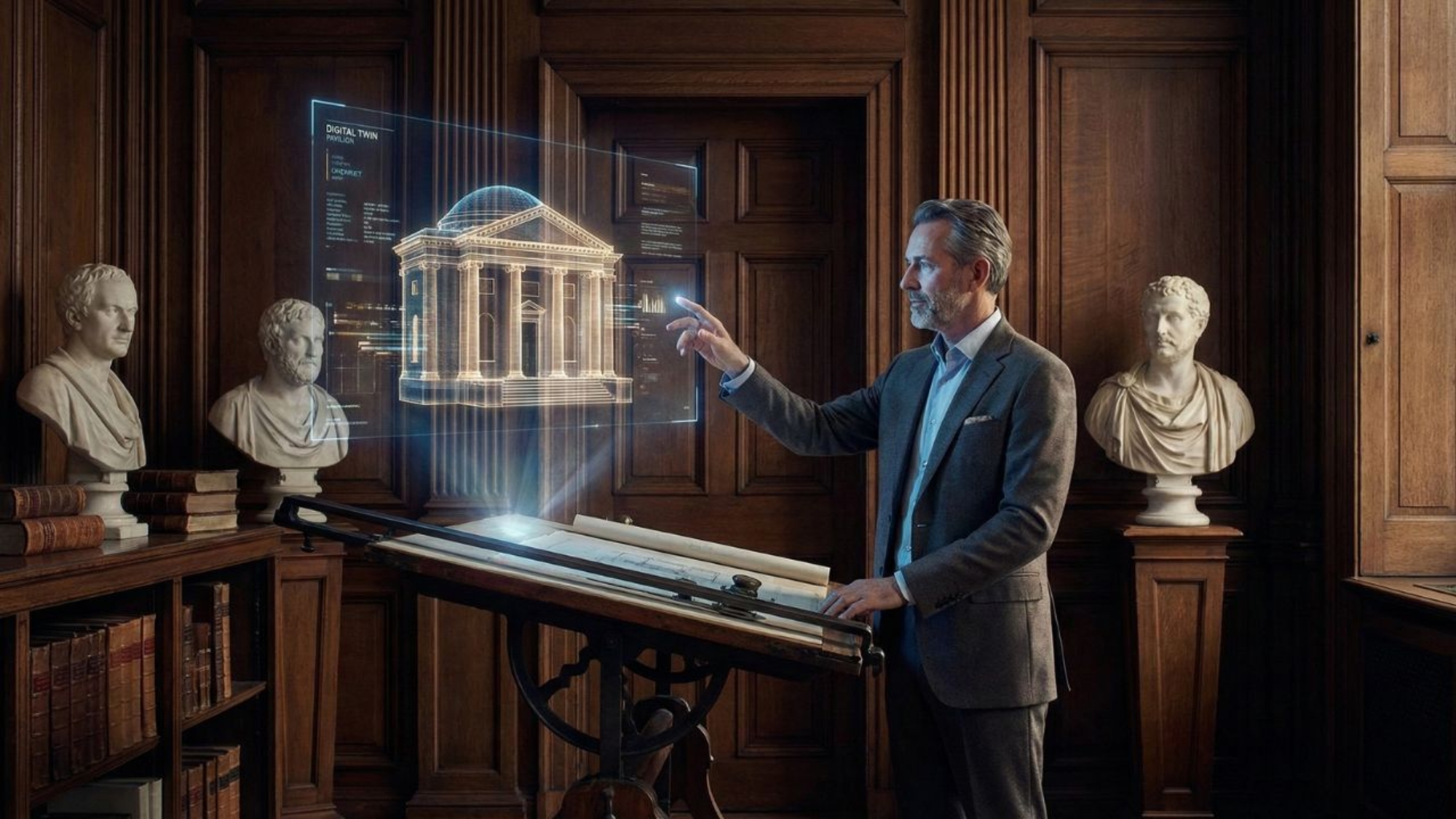
At Bizwity, we believe that “The Business of Awe” is built on transparency and immersion. By utilizing high-fidelity digital twins and immersive VR storytelling, firms can take a client through the “spatial narrative” long before the first stone is laid. It allows you to demonstrate the why behind a radical design choice, turning a potential marketing risk into a compelling, immersive certainty. When a client can feel the atmosphere of a room through digital immersion, you no longer need to rely on the crutch of “Quiet Luxury” to close the deal.