Thumbnails for showcase (19)

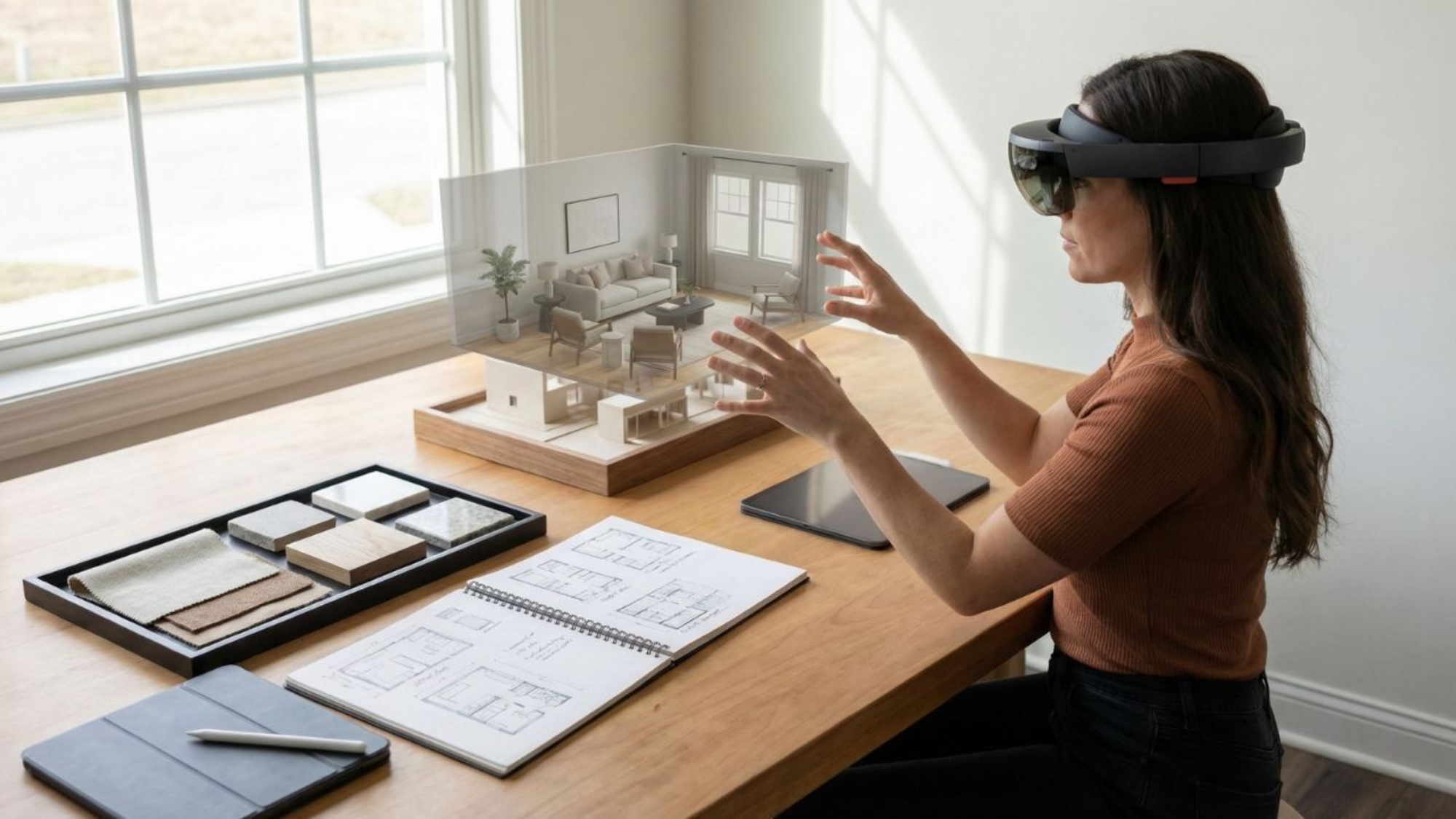
The Interior Architect’s New Toolkit: From Sketchbook to Mixed Reality

The tactile friction of a 4B pencil on a heavy-grain Moleskine is the foundational ritual of our craft. It is the moment where architectural intuition first meets the physical world—a direct, haptic line from the brain to the page. For the Principals of elite design firms in London and Dubai, that sketchbook is more than a tool; it is a repository of “spatial narratives” and raw design soul.

But a profound disconnect occurs the moment that sketch needs to become a reality. We take a fluid, three-dimensional vision and flatten it into 2D CAD drawings or static renders, then ask the client to perform the mental gymnastics required to imagine that vision at scale. In the “Business of Awe,” this translation is where the magic often dissipates. The challenge of 2026 is not to abandon the sketchbook, but to extend its reach through a new, high-fidelity toolkit: Mixed Reality (MR).

The Dilemma: The Spatial Translation Problem

The dilemma for the modern interior architect is the “Scale Gap.” No matter how beautiful a mood board or a 3D render might be, it remains an abstraction. A client standing in a raw, concrete shell in the Chelsea Waterfront or a skeletal penthouse in the Burj Khalifa cannot “see” the bespoke walnut joinery or the way a specific pendant light will define the dining volume through a PDF on an iPad.

Traditional tools fail to convey the phenomenology of space because they are disconnected from the site. This forces the Principal into a cycle of “over-explaining”—using words to compensate for the limitations of the medium. When you have to explain the atmosphere, you have already lost the visceral impact of the design. To secure the trust of high-net-worth individuals, we need a toolkit that allows the vision to inhabit the physical site before the first partition is built.

The Analysis: Digital Classicism in the Third Dimension

The evolution from the sketchbook to Mixed Reality represents the pinnacle of Digital Classicism. It is the use of cutting-edge technology to protect and project classical design values: proportion, light, and material integrity.

Unlike Virtual Reality, which replaces your surroundings, Mixed Reality overlays your “digital craftsmanship” onto the physical world. This creates a new form of Spatial Literacy for both the designer and the client:

  1. Haptic Prototyping in Situ: With MR, you can stand in a raw site and “place” a 1:1 digital twin of a complex marble staircase. You can walk around it, check the sightlines, and feel the “compression and expansion” of the surrounding void. The toolkit allows for forensic design adjustments that were previously only possible after construction.
  2. Materiality in Context: You can overlay high-fidelity digital textures—the patina of aged brass or the grain of hand-planed oak—onto the actual walls of the site. This allows the client to see how the “spatial narrative” reacts to the specific, local light of the room.
  3. The End of Ambiguity: MR removes the “I’ll have to trust you” factor. When the client can see the design inhabit the space through an MR interface, the psychological barrier to approval vanishes. Certainty is the ultimate luxury.

The Strategy: Integrating the New Toolkit

Transitioning your studio’s workflow from the sketchbook to Mixed Reality requires a strategic, phased approach that prioritizes design quality over tech-hype.

  • The “Hybrid Sketch” Workflow: Don’t replace the hand-drawn concept; digitize it early. Use MR to project your initial sketches onto the site at scale. This allows you to “feel” the proportions of your first instincts before committing to heavy BIM modeling.
  • Solving the “Junction” Crisis: Use MR specifically to solve complex spatial junctions—where different materials meet or where structural elements intersect. Seeing these “In-Between” spaces at 1:1 scale on-site prevents costly post-construction revisions.
  • The “Site Walk” Premiere: Replace the traditional boardroom review with an on-site MR walkthrough. Invite the client to the raw site and reveal the “Atmosphere” in its future home. This turns a technical review into a cinematic event.

The Bizwity Perspective: Empowering the Human Hand

At Bizwity, we recognize that technology should never be the “Lead Designer.” Our approach to the modern toolkit is centered on empowering the Principal’s intuition, not replacing it.

We view Mixed Reality as the ultimate empathy engine—a way to ensure the “spatial narrative” you sketched in your Moleskine is the exact reality the client experiences on-site. By bridging the gap between the analog soul and digital precision, we help elite firms maintain their “Founder’s Touch” across every inch of a project. In the 2026 market, the sketchbook provides the soul, but Mixed Reality provides the proof.
Thumbnails for showcase (18)

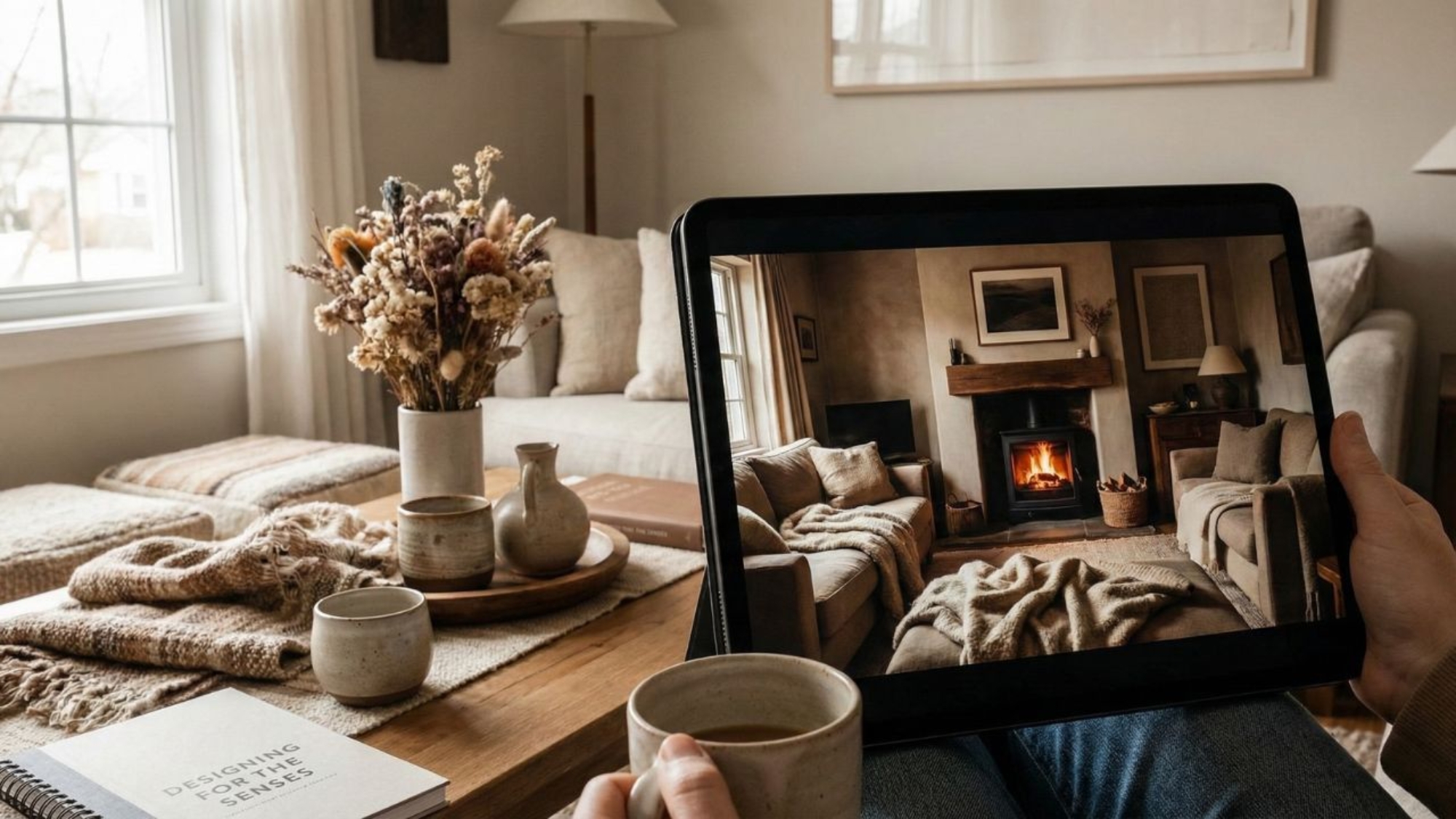
Designing for the Senses: How to Convey “Atmosphere” Through a Screen

An interior is not a collection of objects; it is a weight of air. It is the specific, silent pressure of a heavy wool curtain against a draft, the scent of waxed oak in a heritage library, and the cooling touch of a limestone floor on a mid-August afternoon in Dubai. These are the sensory anchors of “experiential luxury”—the visceral cues that tell a client they are home.

The dilemma for the modern interior designer is that our primary medium of communication has become a flat, glass rectangle. In the transition from the studio to the screen, the “atmosphere” of a project often evaporates. We are presenting high-fidelity images that are technically perfect yet haptically hollow. For the Principal of an elite firm, the challenge of 2026 is bridging this sensory void: how do you make a client feel the atmosphere of a room before the first sample is even ordered?

The Analysis: The Visual-Tactile Gap

The fundamental crisis of digital interior presentation is the “Visual-Tactile Gap.” Traditional renders prioritize geometry and color, but they ignore the phenomenology of space—the study of how we experience our environment through our bodies, not just our eyes.

When a client looks at a standard render, their brain processes it as “visual data.” They see a sofa; they don’t feel the “haptic feedback” of the mohair velvet. They see a window; they don’t perceive the specific quality of light as it filters through a bronze mesh screen. This sensory disconnect forces the client to remain a spectator rather than a participant. In the “Business of Awe,” if the client remains a spectator, they are more likely to haggle over costs. If they become a participant, they are invested in the vision.

To solve this, we must shift our digital strategy from “showing” to “simulating.” We must embrace Digital Classicism—using the highest forms of technology to honor the most ancient of human senses.

The Strategy: Engineering Sensory Proxies

Conveying atmosphere through a screen requires a move toward “Digital Craftsmanship.” You are no longer just an interior designer; you are a sensory orchestrator.

  1. Light as a Material, Not an Effect: In your digital presentations, treat light as a physical presence. Use real-time ray tracing to simulate “volumetric lighting”—the way dust motes dance in a sunbeam or how light “bleeds” around a soft edge. This creates “atmospheric density,” signaling to the client’s subconscious that the space has depth and air.
  2. Materiality as Behavior: Stop presenting static textures. In an immersive or real-time environment, show how materials behave. Show how a silk wallpaper shifts its sheen as the viewer moves, or how a hand-planed wood floor reflects a low winter sun. When materials react to their environment, the brain perceives them as “true,” triggering a tactile memory.
  3. The Acoustic Narrative: Atmosphere is 50% sound. When presenting a digital twin or an immersive walkthrough, integrate “Spatial Audio.” The slight echo of a stone-clad hallway transitioning into the dampened, hushed tones of a carpeted master suite provides a powerful sensory cue that reinforces the spatial narrative.

The Bizwity Perspective: The Immersion of Empathy

At Bizwity, we understand that the greatest barrier to design excellence is the “empathy gap” between the architect’s imagination and the client’s perception.

We view immersive technology not as a digital replacement for the physical world, but as its most sophisticated proxy. By utilizing high-fidelity real-time engines, we allow Principals to place their clients inside the “atmosphere” long before the site is even cleared. When a client can experience the “haptic soul” of an interior through an immersive journey—hearing the silence, seeing the light-play, and perceiving the material weight—the technology disappears. What remains is a profound human connection to the space. In the 2026 market, the firm that can deliver atmosphere through a screen is the firm that commands the most lucrative commissions.

Thumbnails for showcase (17)

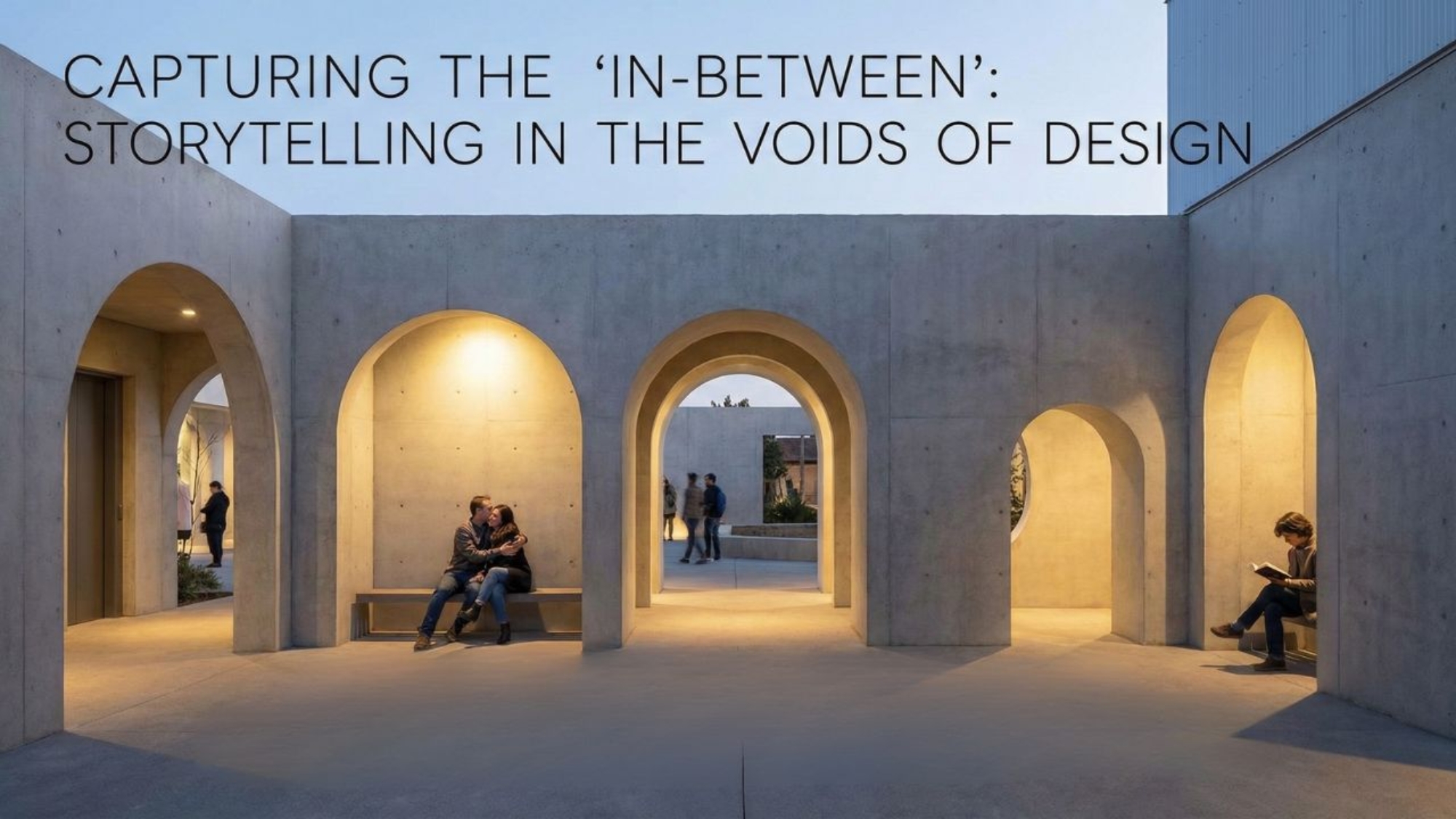
Capturing the “In-Between”: Storytelling in the Voids of Design

We are trained to obsess over the “objects” of architecture. We labor over the curvature of a staircase, the thickness of a marble slab, and the structural integrity of a cantilever. Yet, for the inhabitant, the most profound experiences of a building often occur not within the objects themselves, but in the spaces between them.

The “In-Between”—the corridors, the thresholds, the shadow-gaps, and the voids—is where the real story of a design lives. It is the pause between notes that makes the music. For the principals of elite firms in London and Dubai, the ability to master these voids is what separates a high-end “project” from a “spatial narrative” that commands a legacy.

The Dilemma: The Error of the Object-Centric Portfolio

The dilemma for the modern architect is that traditional portfolios are fundamentally biased toward “things.” We photograph rooms as if they were still-life paintings. We showcase a chair in a corner or a kitchen island as a heroic centerpiece. This creates a fragmented experience for the client. They see a collection of beautiful objects, but they fail to perceive the phenomenology of the void.

When we ignore the “In-Between,” we lose the connective tissue of luxury. In elite residential and commercial design, true sophistication is found in the transition. If your digital presentation skips from the “Grand Entrance” to the “Master Suite” without acknowledging the journey through the silence of the corridor, you are failing to sell the atmosphere. You are selling the hardware, but forgetting the soul. In the Business of Awe, the void is where the emotional resonance is built.

The Analysis: The Architecture of the Void

The “In-Between” is not “empty space”; it is the medium through which light, sound, and human movement travel. In the philosophy of Digital Classicism, the void is treated with the same level of digital craftsmanship as the solid.

  1. Threshold as Narrative Shift: A threshold is more than a doorway; it is a psychological gear-change. By focusing on the “In-Between,” you can design the feeling of transition—how the air changes as one moves from a sun-drenched courtyard into a cool, concrete-walled gallery.
  2. The Luxury of Compression: Classical architecture understood that to appreciate a great room, one must first pass through a smaller, quieter one. This is the “spatial narrative” of tension and release.
  3. Shadow as Substance: In the voids, shadow becomes a material. The way a shadow falls across a recessed floor-gap or a “blind” hallway is where the mystery of a design is held.

The Strategy: Designing for the Silence

To capture the “In-Between” in your business development and design process, you must shift your lens away from the heroic and toward the subtle.

  • Document the “Non-Spaces”: In your next journal entry or social feature, don’t show the living room. Show the view from the hallway looking into the living room. Frame the void. This demonstrates a level of design maturity that speaks directly to sophisticated clients.
  • The Pacing of the Walkthrough: Use your digital presentations to linger in the transitions. Don’t rush the client into the big “reveal.” Let them sit in the silence of the void for a moment. This builds anticipation and proves you have mastered the “haptic feedback” of the entire journey.
  • Materialize the Void: Treat the air in your voids as a design element. Use immersive technology to simulate the specific lighting and acoustic qualities of these spaces. If a client can feel the coolness of a void in a VR environment, they will trust you with the solids.

The Bizwity Perspective: Immersive Voids

At Bizwity, we believe that the most powerful stories are often told in the whispers. Our approach to “Digital Classicism” ensures that the voids in your design are never “empty” in a digital twin.

By utilizing high-fidelity real-time rendering, we allow you to showcase the “In-Between” with the same sensory detail as your primary spaces. We capture the way light scatters in a hallway or how sound dampens in a transition zone. We don’t just help you visualize your buildings; we help you prove the value of your silences. In the Business of Awe, the firm that masters the void is the firm that creates an unbreakable human connection to their work.

Thumbnails for showcase (16)

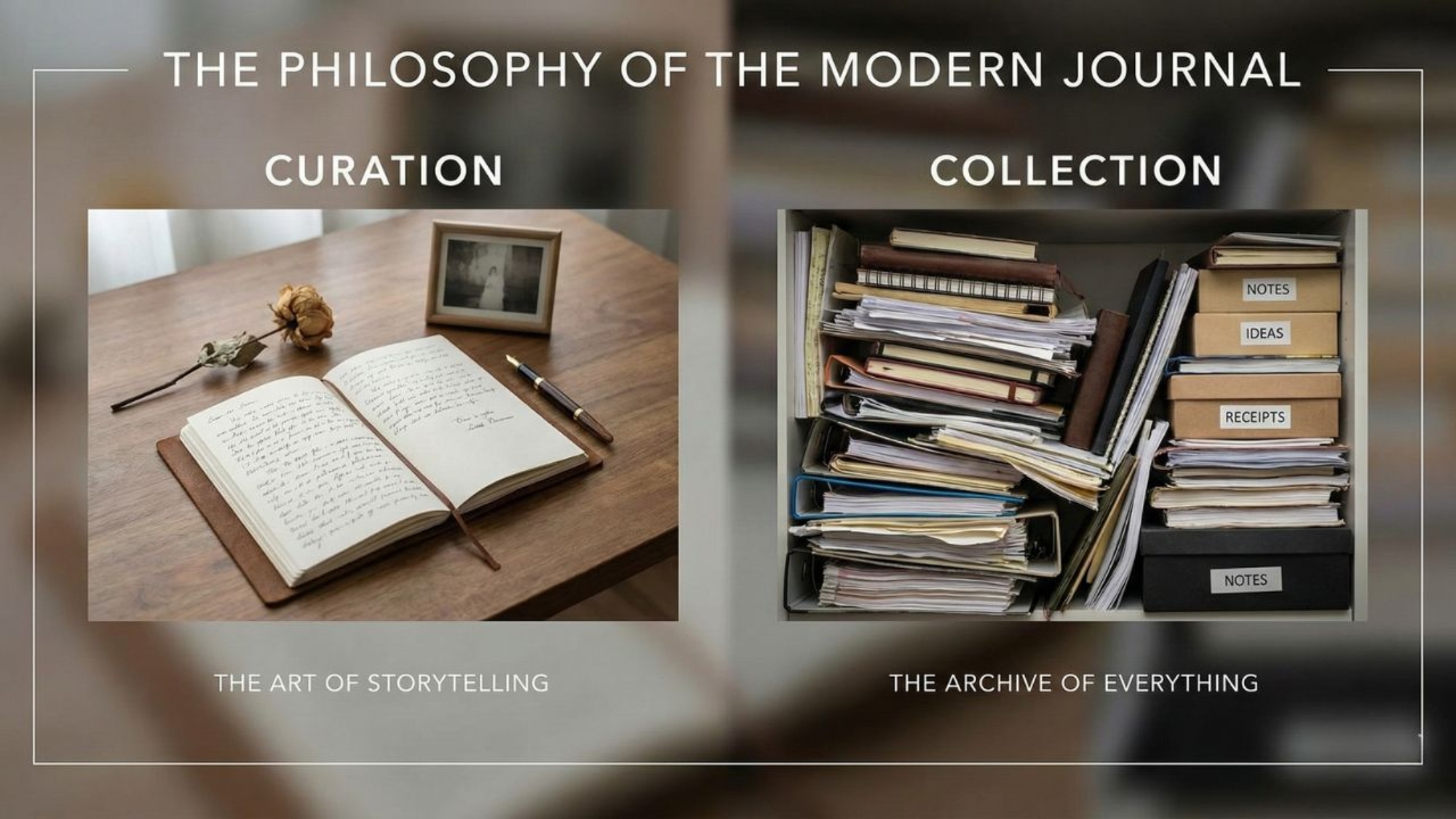
Curation vs. Collection: The Philosophy of the Modern Journal

There is a specific, quiet exhaustion that settles over a Principal during the final stages of a website redesign or the assembly of a new monograph. You are surrounded by a decade of high-fidelity imagery: the heritage restoration in Kensington, the brutalist retreat in the Al Marmoom desert, the minimalist penthouse in Tribeca. Each project represents thousands of hours of “spatial narrative” and meticulous “digital craftsmanship.” Yet, when viewed together in a grid, the individual soul of each work begins to blur.

You find yourself looking at a collection, when what your brand truly requires is a curation.

In the “Business of Awe,” the difference between these two states is the difference between being an archivist and being a visionary. For the elite firms of London and Dubai, the modern portfolio must transcend the role of a digital filing cabinet. It must become a “Living Journal”—a curated intellectual argument that proves your inevitable value to the world’s most sophisticated clients.

The Dilemma: The Gravity of the “More” Trap

The dilemma for the successful Founder is the instinct to hoard. We believe, perhaps subconsciously, that a massive collection of past work serves as a shield against risk. We think that showing everything proves we can do anything.

However, in the hyper-saturated markets of 2026, volume is a commodity. When a high-net-worth client or a royal developer lands on a portfolio that feels like a “collection,” they experience cognitive fatigue. Static websites and PDF decks that attempt to show every facet of a firm’s history often end up saying nothing at all. They lack the “phenomenology of space” because they prioritize quantity over the emotional resonance of a singular, curated message. You aren’t inviting the client into a story; you are asking them to sort through your laundry.

The Analysis: The Editor as Architect

Curation is an act of violence against the mediocre. To curate is to select, to frame, and—most importantly—to exclude.

In the philosophy of Digital Classicism, the Modern Journal serves as the bridge between your past rigor and your future potential. A collection is a record of what you did; a curation is a manifesto of what you believe.

  1. The Narrative Filter: A curation is built around a “spatial narrative.” Instead of showing five different kitchens, you show one specific transition from a light-filled breakfast room to a moody, subterranean cellar. You are selling the logic of the transition, not the specifications of the cabinetry.
  2. Intellectual IP over Imagery: A “collection” focuses on the finished photo. A “curation” focuses on the intellectual capital—the sketches, the site constraints, and the “haptic feedback” of the design process. This positions the Principal as a consultant of “experiential luxury,” rather than a vendor of blueprints.
  3. The Aura of Scarcity: By curating your output down to the absolute pinnacle of your work, you create an aura of scarcity. You signal to the London and Dubai markets that your time is a limited resource and your vision is reserved for those who value the “Business of Awe” over mere square footage.

The Strategy: Pruning for Growth

To transition from a “collection” to a “curated journal,” the Principal must adopt an editorial mindset.

  • Kill Your Darlings: Remove any project from your public-facing journal that does not align with the type of project you want to win tomorrow. If you want to design museums but your portfolio is 80% mid-market residential, you are trapped in your own collection.
  • Contextualize the “Awe”: Every project entry must lead with a provocative observation about the “phenomenology” of that specific space. Don’t tell the client what it is; tell them why it matters.
  • The 70/30 Rule: Dedicate 70% of your digital presence to your “curated peaks”—the work that defines your legacy. Use the remaining 30% for “Process Journals”—the behind-the-scenes look at your digital craftsmanship and VR explorations.

The Bizwity Perspective: The Immersive Curator

At Bizwity, we recognize that the greatest challenge for a busy Principal is finding the time to edit. You are often too close to the work to see the narrative threads that connect your finest moments.

We view immersive technology as the ultimate tool for curation. By utilizing high-fidelity digital twins and real-time storytelling, we help firms move away from “collecting” renders and toward “curating” experiences. We allow you to take a client through a singular, perfected “spatial narrative” that encapsulates your entire philosophy in minutes.

A “Bizwity Journal” isn’t a website; it’s a high-end, immersive concierge that does the selling for you. It ensures that while you are focused on design excellence, your digital presence is performing the “Silent Sale,” positioning you not just as an architect, but as the inevitable curator of your client’s future.

Thumbnails for showcase (15)

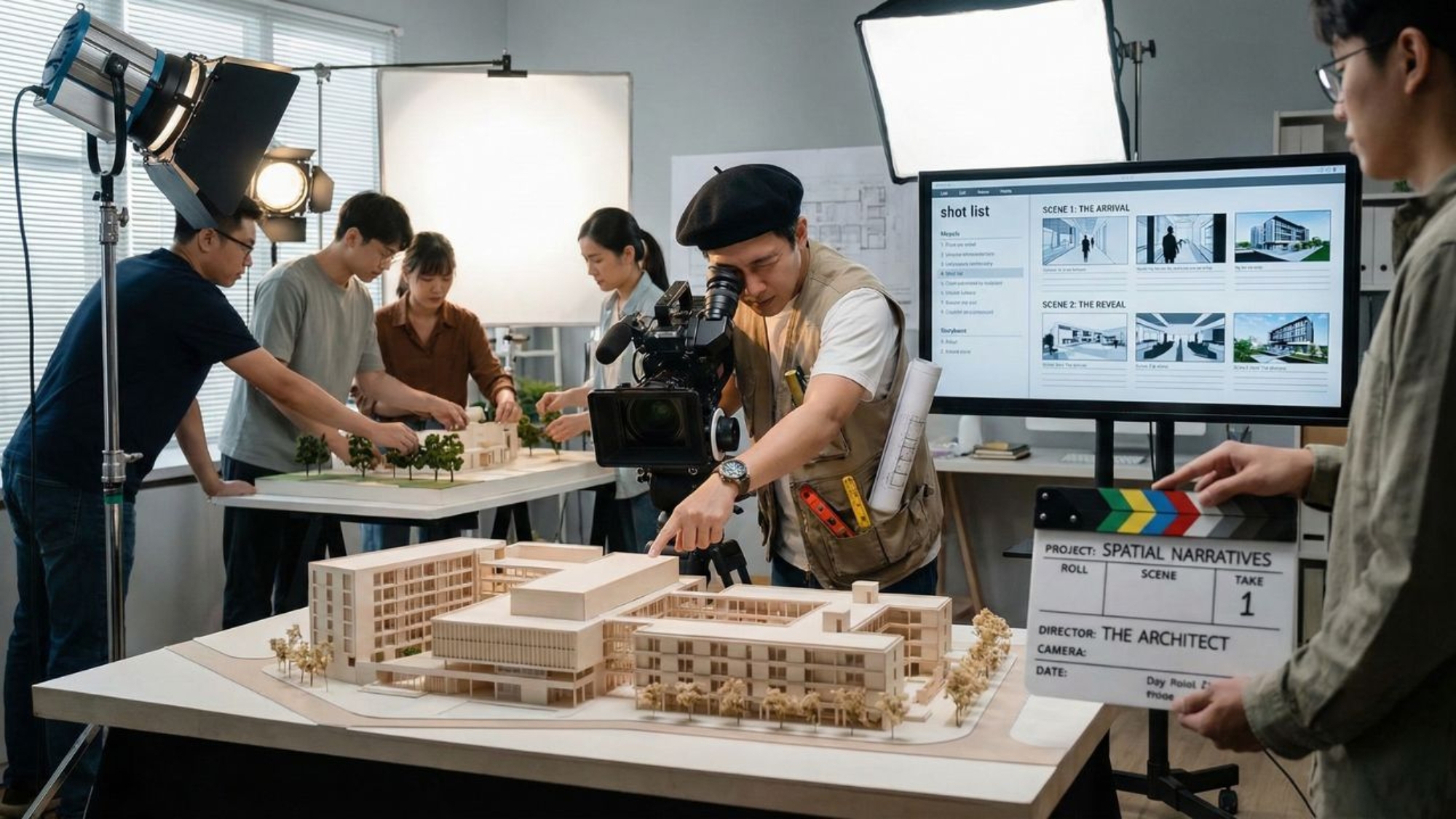
Why Architects Should Think Like Film Directors

Consider the opening sequence of a masterpiece in cinema. There is no dialogue, yet you understand the stakes, the atmosphere, and the soul of the story through the deliberate movement of the lens—the way light catches a fraying curtain, the rhythm of a character’s footsteps echoing in a hall, the slow, agonizing reveal of a horizon.

Now, consider the way most elite architectural firms present a £20 million project. They offer a static site plan, a few disjointed renders, and perhaps a material board. The “story” is fragmented, trapped in the white space between slides. The client is asked to be the editor, the director, and the audience all at once. For the Principal in London or Dubai, this is a profound missed opportunity. To sell the “Business of Awe,” you must stop thinking in floor plans and start thinking in frames. You must think like a film director.

The Dilemma: The Static Perspective

The fundamental challenge of high-end design is that while a building is a three-dimensional object, the experience of it is a four-dimensional journey. It is a sequence of events unfolding over time.

Traditional architectural education trains us in the “God’s-eye view”—the plan and the section. These are essential for construction, but they are useless for empathy. When we present our work through static media, we are offering the client the script but denying them the movie. This “Static Perspective” fails to communicate the phenomenology of space—the emotional transition from a grand, public entrance to the haptic, intimate sanctuary of a private study. If the client cannot perceive the narrative arc of your design, they cannot fully value your genius. They see a structure; they don’t see a life.

The Analysis: Mise-en-scène and Spatial Montage

In cinema, the term mise-en-scène refers to everything captured within the frame: the arrangement of actors, the lighting, the decor, and the textures. In Digital Classicism, the architect uses these same principles to engineer experiential luxury.

  1. The Choreographed Sequence (The Montage): A film director understands that a close-up followed by a wide shot creates a specific emotional impact. Architects must apply this “spatial montage.” How does the compression of a timber-lined foyer enhance the expansion of the marble-clad atrium? By thinking like a director, you prioritize the pacing of the reveal over the static beauty of the room.
  2. The Lighting Narrative: Light is the director’s most potent tool for directing the eye and setting the mood. In architectural storytelling, we must use light not just for visibility, but for “spatial punctuation.” We use high-fidelity digital twins to simulate the “cinematic glow” of golden hour in a specific courtyard, proving to the client that we have mastered the atmosphere of their future reality.
  3. Haptic Pacing: A director controls the speed of a scene. An architect controls the speed of a human. By designing “visual anchors” or tactile textures at key transition points, you are directing the client’s movements. This is “Digital Craftsmanship” at its most sophisticated—using technology to ensure the human experience is choreographed to perfection.

The Strategy: From Presentation to Premiere

To shift your practice toward a cinematic model, you must treat your client meetings as “premieres” rather than reviews.

  • Script the Journey: Before the meeting, write a one-page narrative of the “walkthrough.” Describe the scents, the sounds, and the emotional shifts. This establishes the “Spatial Narrative” before a single image is shown.
  • Leverage Real-Time Immersion: Abandon the linear PDF. Use real-time engines to allow the client to “direct” their own experience. Let them move through the space, change the time of day, and test material interactions. This grants them a sense of “pre-occupancy” that no static image can provide.
  • Focus on the “Opening Shot”: The first ten seconds of an immersive experience are the most critical. Ensure your digital entry point captures the “soul” of the project immediately. Use atmospheric density and realistic textures to trigger an immediate, visceral “Awe.”

The Bizwity Perspective: The Director’s Monitor

At Bizwity, we view our immersive platforms as the architect’s “director’s monitor.” We provide the tools that allow you to step inside your script and see how the movie is playing out before the first stone is laid.

By bridging the gap between classical design philosophy and cinematic digital storytelling, we help Principals communicate the intangible. We don’t just help you show a project; we help you premiere a vision. In the “Business of Awe,” the firm that can direct the client’s emotional journey is the firm that inevitably wins the commission.

Thumbnails for showcase (14)

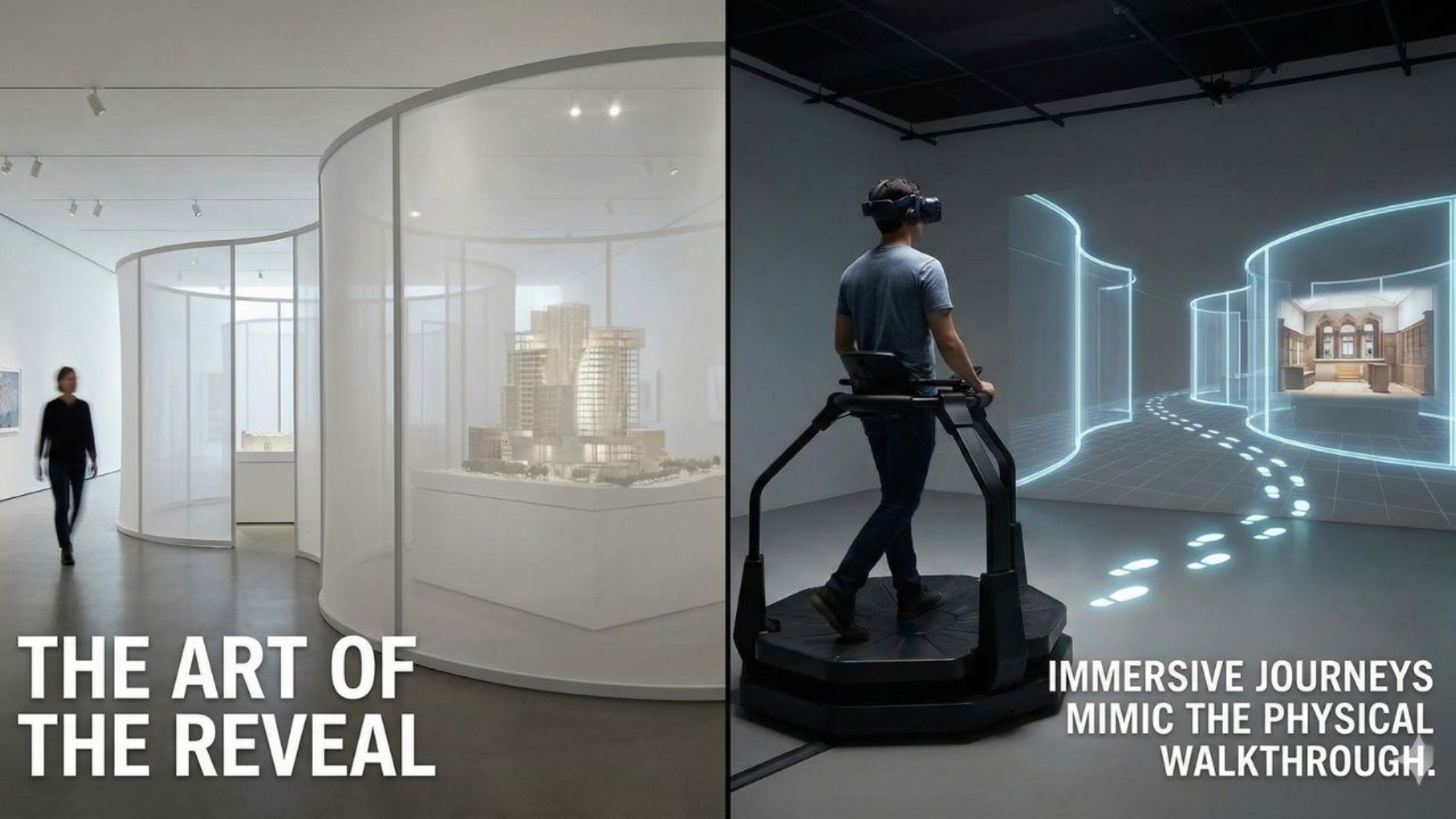
The Art of the Reveal: How Immersive Journeys Mimic the Physical Walkthrough

There is a precise sequence of events that occurs when a guest enters a masterfully designed space—be it a brutalist villa in the Emirates or a heritage townhouse in Belgravia. It is the choreographed transition from the street to the sanctuary. It begins with the weight of the entry door, followed by a compressed hallway that suddenly explodes into a double-height atrium, finally settling into the soft, haptic embrace of a private library.

In the trade, we call this the “The Reveal.”

For the Principals of elite firms, the “Reveal” is the climax of the spatial narrative. It is where the intellectual rigor of the plan meets the emotional response of the inhabitant. However, a profound challenge has emerged in our digital-first era: how do you translate the physical gravity of a walkthrough into a presentation? For years, we have relied on a scattered collection of perspective renders—static snapshots that tell the client what the building looks like, but utterly fail to communicate the tempo of how it feels to move through it.

The Dilemma: The Static Disconnect

The dilemma is one of “Narrative Continuity.” A traditional architectural presentation is a series of disjointed leaps. You show the facade, then “jump” to the kitchen, then “jump” to the master suite. This prevents the client from understanding the most critical element of high-end design: the transition.

When we skip the “connective tissue” of a building, we lose the phenomenology of space. We lose the way a view is teased through a slatted screen before it is fully revealed. We lose the subtle change in acoustics as one moves from stone to carpet. Without the walkthrough, the client is merely looking at a catalog of rooms. In the Business of Awe, if the client cannot experience the journey, they cannot value the destination.

The Analysis: The Choreography of Digital Classicism

To solve this, the elite practitioner must move beyond “visualization” and toward “spatial choreography.” This is the cornerstone of Digital Classicism—using the most advanced real-time engines to uphold the ancient architectural principle of the promenade architecturale.

An immersive digital journey mimics the physical walkthrough by honoring three psychological triggers:

  1. Compression and Expansion: By utilizing real-time VR, we can replicate the physical sensation of moving through a narrow, darkened corridor before emerging into a light-filled volume. This creates a physiological “release” in the client, mimicking the exact emotional hit they will feel in the finished building.
  2. The Tease (Le Coup d’Oeil): In a live digital twin, we can choreograph the “oblique view.” We can show the client how a garden is glimpsed through a series of layered portals. This builds anticipation—a key component of experiential luxury.
  3. Haptic Pacing: A physical walkthrough has a rhythm. You stop to touch a railing; you pause to look at how the light hits a plaster wall. Immersive storytelling allows the client to set their own pace, turning a passive “watching” experience into an active “dwelling” experience.

The Strategy: Designing the Digital Promenade

For the Founder looking to secure high-value commissions, the “Reveal” must be the centerpiece of the pitch.

  • Kill the “Fly-through”: Static, pre-rendered fly-through videos are the digital equivalent of being stuck on a bus. They are rigid and disempowering. Instead, use a live, interactive environment where the client—or the Principal—can deviate from the path. This signals a design that is robust from every angle.
  • Focus on the “Thresholds”: Spend disproportionate time in your presentation on the doors, the stairs, and the hallways. These are the narrative hinges of the project. If you can sell the transition, the rooms will sell themselves.
  • The “Atmospheric Pivot”: Use real-time tech to show the “Reveal” under different conditions. Show how the grand entrance transforms from the bright, sharp light of a Dubai noon to the moody, candle-lit intimacy of an evening event.

The Bizwity Perspective: Restoring the Narrative Arc

At Bizwity, we believe that architecture is a form of slow-release storytelling. The “Business of Awe” isn’t about the single, spectacular image; it’s about the cumulative impact of a perfectly sequenced journey.

By leveraging immersive technology, we help Principals restore the narrative arc of their work. We allow your clients to “walk” the halls of their future home with the same sensory nuance and emotional weight as a physical site visit. When you can master the “Art of the Reveal” in a digital environment, you aren’t just presenting a design—you are providing a preview of a legacy.

Thumbnails for showcase (13)

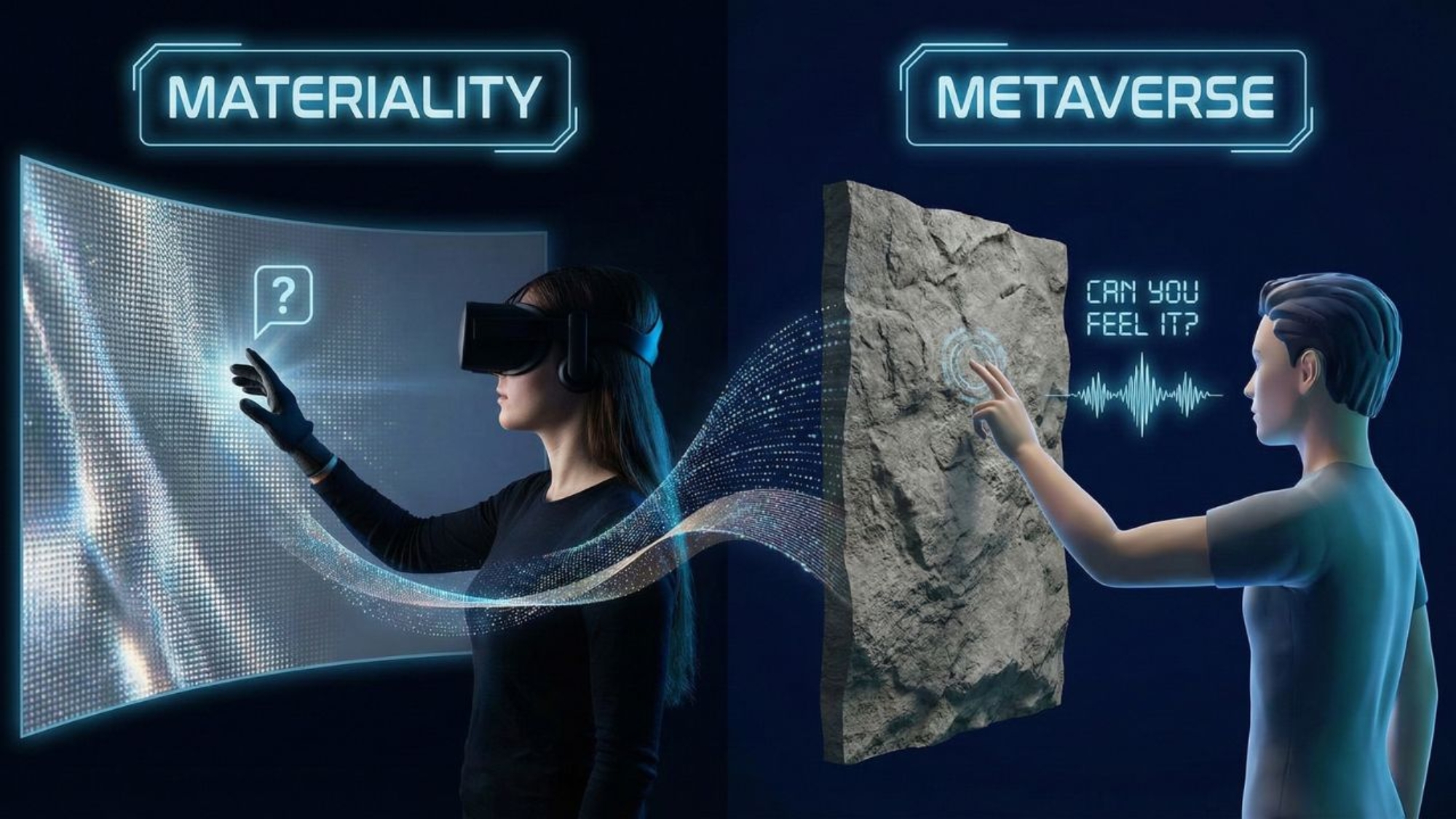
Materiality in the Metaverse: Can You Truly “Feel” a Digital Texture?

Close your eyes and imagine running your hand over a slab of cold, honed Pietra Gray marble. You feel the microscopic fissures, the slight temperature drop where the stone meets the air, and the subtle, gritty resistance of a natural finish. Now, imagine trying to convey that exact visceral sensation to a client in a Dubai boardroom using a flat, 2D render on a MacBook screen.

The gap between those two experiences is where the most ambitious projects often falter. For the Principal of an elite firm, materiality isn’t just a specification; it is the “haptic soul” of the building. Yet, as we move toward the metaverse and increasingly digital workflows, we face a profound dilemma: in a world of pixels and polygons, can we ever truly communicate the feeling of a physical surface?

The Dilemma: The Sensory Divorce of the Digital Portfolio

The traditional architectural presentation has long suffered from a “sensory divorce.” We spend months sourcing the perfect hand-charred cedar or the exact patina of oxidized bronze, only to have that effort flattened into a static image. Standard CGI, no matter how “photorealistic,” often feels clinical. It lacks what we call the “Integrity of Imperfection”—the tiny, chaotic details that tell the human brain a material is real.

For a high-net-worth client, luxury is experienced through the senses. When a digital presentation fails to evoke a tactile response, the client remains emotionally detached. They are looking at a picture of a room, rather than feeling the atmosphere of a home. This failure of medium forces the architect to rely on physical material boards—cumbersome, expensive, and often impossible to transport for global projects. If the client can’t “feel” the materiality, they cannot fully commit to the vision.

The Analysis: Digital Craftsmanship and the Physics of Awe

The solution is not to abandon the digital, but to master Digital Craftsmanship. In the philosophy of Digital Classicism, materiality in the metaverse is not about “looking” real; it is about behaving real.

To bridge the tactile gap, elite firms are shifting from static visualization to high-fidelity “Physical Simulations.” This involves three key pillars of digital materiality:

  1. Light-Material Interaction (LMI): True materiality is defined by how light behaves. In 2026, using real-time ray tracing, we can simulate “sub-surface scattering”—the way light penetrates a piece of translucent onyx or the way it catches the weave of a heavy linen wallcovering. When the light moves naturally, the brain begins to “feel” the texture.
  2. The “Haptic Proxy”: While we cannot yet reach through a screen to touch stone, we can use “visual haptics.” By rendering the microscopic “noise” of a material—the dust in a crevice or the slight wear on a leather armrest—we trigger the viewer’s tactile memory. We aren’t showing them a texture; we are reminding them of a feeling they already know.
  3. Atmospheric Density: Materiality is never isolated. A stone floor feels different in the humid air of a London conservatory than it does in the dry heat of a Dubai villa. Digital Classicism uses immersive tech to simulate the atmosphere around the material, providing the context that makes the texture feel grounded in reality.

The Strategy: Moving Beyond the Material Board

To leverage digital materiality for business growth, Principals must shift their strategy from display to immersion.

  • The “Material Narrative” Pitch: Instead of showing a grid of materials, tell the story of one. Use a high-fidelity “Micro-Vignette” to show how a specific wood grain evolves under different lighting conditions throughout the day.
  • Virtual Sampling: Replace the physical material board with a “Digital Twin” of the material library. Allow clients to swap out textures in a VR environment in real-time. This doesn’t just save time; it empowers the client to participate in the “phenomenology of space.”
  • The Specifier’s Authority: Position your use of high-tech material simulation as a form of risk mitigation. Prove to the client that you have tested every material interaction in a digital environment before a single order is placed.

The Bizwity Perspective: Restoring the Human Touch

At Bizwity, we believe that the “spatial narrative” is incomplete without a sensory connection. Our approach to “Digital Classicism” is designed to ensure that the technology never feels like a barrier between the architect and the artisan.

By utilizing advanced game-engine technology and immersive storytelling, we help firms create digital experiences where the materiality is so dense, so present, that the client forgets they are looking at a screen. We don’t just build virtual models; we build “Experiential Prototypes.” In the Business of Awe, the firm that can make a client “feel” a digital texture is the firm that creates the most compelling reason to build the physical reality.

Thumbnails for showcase (12)

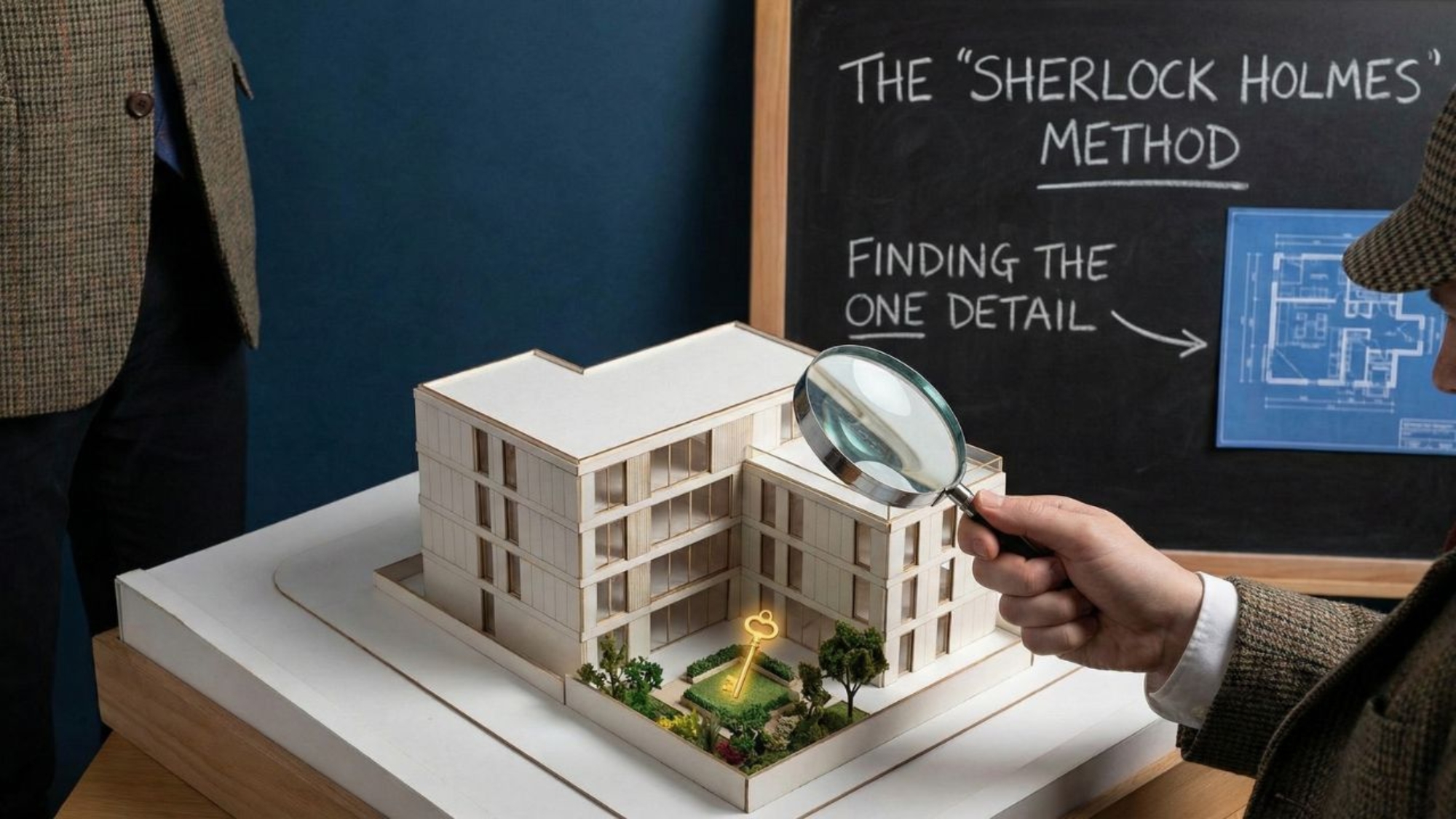
The “Sherlock Holmes” Method: Finding the One Detail That Sells the Project

In the high-stakes galleries of London’s property markets and the sleek presentation suites of Dubai, there is a common, fatal error: the “Everything, Everywhere, All at Once” pitch. Architects, fueled by a justifiable pride in their rigor, attempt to sell the client on the entire building—the structural grid, the HVAC efficiency, the basement car lift, and the rooftop garden—all with equal weight.

But high-net-worth clients do not fall in love with a structural grid. They fall in love with a moment.

To win the most prestigious commissions in 2026, the elite Principal must adopt what we call the “Sherlock Holmes” Method. It is the art of forensic design—the ability to identify the one singular, obsessive detail that encapsulates the entire “spatial narrative” and makes the project feel inevitable. In the “Business of Awe,” the smallest detail is often your biggest closer.

The Dilemma: The Curse of the Generalist Pitch

The dilemma for the sophisticated designer is that your work is inherently complex, yet your client’s attention is a scarce, expensive resource. When you present forty slides of varying importance, you are asking the client to do the editorial work of finding the “soul” of the project themselves.

If they can’t find it, they default to looking at the price.

A “generalist” pitch creates a lack of emotional “haptic feedback.” It feels like a commodity. Without a focal point—a singular “artifact of design”—the project lacks a hook for the client’s memory. They leave the meeting remembering a “nice house,” rather than the “house with the monolithic bronze door that sounds like a vault when it closes.” Without the detail, you lack the legend.

The Analysis: Forensic Architecture and the Power of the “Parti”

The “Sherlock Holmes” Method is based on the classical concept of the Parti—the “big idea” of a building—but it focuses that idea into a microscopic lens. It is about finding the one “Design DNA” strand that proves the brilliance of the whole.

In the realm of Digital Classicism, this method relies on three forensic steps:

  1. The Observational Audit: Before drawing a line, observe the client’s “unspoken rituals.” Do they have a specific way they handle their watch collection? Is there a particular way they prefer to watch the sunrise? Sherlock Holmes famously observed the wear on a watch to understand its owner; you must observe the “phenomenology” of their life to find the detail.
  2. The Artifact of Awe: Once you identify the ritual, you design the “Artifact.” This might be a bespoke staircase handrail that perfectly matches the ergonomic grip of the owner, or a skylight positioned so that on the client’s birthday, the sun hits a specific piece of art. This isn’t just a feature; it’s a narrative proof.
  3. The Scale Shift: In your presentation, you reverse the traditional order. You don’t start with the site plan; you start with the detail. By showing the client that you have solved for their most intimate, micro-moment, you subconsciously signal that you have also mastered the macro-complexity of the entire build.

The Strategy: Engineering the “Hero Detail”

To implement this method, you must shift your design and presentation workflow toward “Narrative Density.”

  • Lead with the Micro: In your next proposal, dedicate 30% of the time to a single, high-fidelity “Experience Vignette.” If it’s a penthouse, don’t just show the living room; show the custom-carved stone plinth where they will place their morning espresso.
  • The “Haptic Proxy”: Use immersive tech to let the client “interact” with the hero detail. Let them virtually feel the weight of the bespoke handle or see the light catch the grain of the rare marble.
  • The ROI of Obsession: Frame the detail not as an “extra,” but as the “Asset Value” of the firm’s intellectual capital. Explain the engineering and “digital craftsmanship” required to make that one moment happen. This justifies your fees by proving your level of care.

The Bizwity Perspective: Immersive Forensic Storytelling

At Bizwity, we recognize that the “Sherlock Holmes” Method requires a level of visual fidelity that traditional renders cannot provide. You cannot sell a “Hero Detail” if the digital representation looks like a plastic toy.

We help firms use immersive technology to perform “Spatial Forensic” presentations. We allow you to take the client from a 1:1,000 site view down to a 1:1 material detail in a single, fluid motion. By focusing the power of “Digital Classicism” on the singular moments that matter most to your client, we turn your presentation into a narrative of inevitability. We don’t just show them a building; we show them that you have noticed the things no one else has. And that, more than anything, is what closes the deal.

Thumbnails for showcase (11)

Virtual Twin or Digital Ghost? Making Your Project Live Online

There is a specific kind of disappointment that occurs six months after a landmark project is handed over. You, the Principal, visit the site—perhaps a luxury boutique hotel in Dubai or a high-spec residential development in Chelsea—and you find that the “spatial narrative” you so carefully crafted has begun to fray. The lighting presets have been altered, the bespoke furniture has been rearranged, and the building’s performance data is a black box. The “soul” of the design, once vibrant, has become a “Digital Ghost”—a memory of a vision that no longer matches the reality.

For the elite architecture firms of 2026, the project doesn’t end at the ribbon-cutting. To maintain “Design Quality” and “Business Viability” long-term, we must move beyond the static handover. We must transition from delivering a building to delivering a Virtual Twin: a living, breathing digital counterpart that ensures your architectural intent outlives the construction phase.

The Dilemma: The Post-Occupancy Void

The traditional architectural model is a linear path to a dead end. We invest thousands of hours into “digital craftsmanship”—BIM models, high-fidelity renders, and material specifications—only to hand over a set of static PDFs and O&M manuals that will never be opened.

The dilemma is that without a living digital connection, the architect loses their “Authority” the moment the keys are turned. You have no way to track how the building is performing, how the inhabitants are actually moving through the spaces you designed, or whether the “experiential luxury” you promised is being maintained. The building becomes a ghost of your intent, and you lose the data-driven insights that should be fueling your next seven-figure commission.

The Analysis: The Anatomy of a Living Twin

A “Virtual Twin” is not merely a 3D model; it is a dynamic, data-integrated platform. In the philosophy of Digital Classicism, the Virtual Twin is the ultimate marriage of timeless design and futuristic stewardship. It differs from a “Digital Ghost” in three fundamental ways:

  1. Bi-Directional Data Flow: A Digital Ghost is a snapshot of the past. A Virtual Twin is connected to the physical building via IoT sensors. It knows the real-time temperature of the atrium, the occupancy levels of the gallery, and the energy consumption of the HVAC. It is “haptic feedback” at a structural scale.
  2. Predictive Maintenance vs. Reactive Repair: A Virtual Twin allows the firm to offer “Architecture as a Service.” You can predict when a bespoke mechanical facade element will need servicing before it fails, preserving the building’s “Legacy” and reducing the client’s long-term risk.
  3. The Feedback Loop of Awe: By analyzing how people actually use the space, you gain irrefutable data on the “ROI on design.” If the Virtual Twin shows that the “experiential zones” you designed are the most occupied, you have the proof you need to command higher fees for your next project.

The Strategy: Engineering the “Live” Handover

To avoid leaving behind Digital Ghosts, firm owners must restructure their deliverables to prioritize longevity.

  • Productize the “Living Model”: Don’t give the BIM model away for free. Offer a “Digital Stewardship” contract where your firm manages the Virtual Twin for the client. This creates recurring revenue and keeps you positioned as a strategic partner, not just a one-time vendor.
  • Integrate User Experience (UX) Data: Use the Virtual Twin to track the “phenomenology of space.” How does light affect occupancy? How does spatial flow change during different seasons? Turn these insights into “Intellectual IP” that distinguishes your firm from the competition.
  • The “Digital Concierge” Interface: Provide the client with a high-end, immersive interface to interact with their Virtual Twin. Make the building’s data as beautiful and accessible as the building itself.

The Bizwity Perspective: Stewardship as the Ultimate Sales Tool

At Bizwity, we believe that the most powerful marketing tool is a project that works perfectly ten years after completion.

By helping firms implement Virtual Twin technology, we are bridging the gap between “Design Excellence” and “Business Growth.” A Virtual Twin isn’t just a tech asset; it’s a relationship asset. It allows you to stay in the room with your client, providing value and proving your design’s worth every single day. In the “Business of Awe,” the firm that makes their projects live online is the firm that never has to fight for their next client.

Thumbnails for showcase (10)

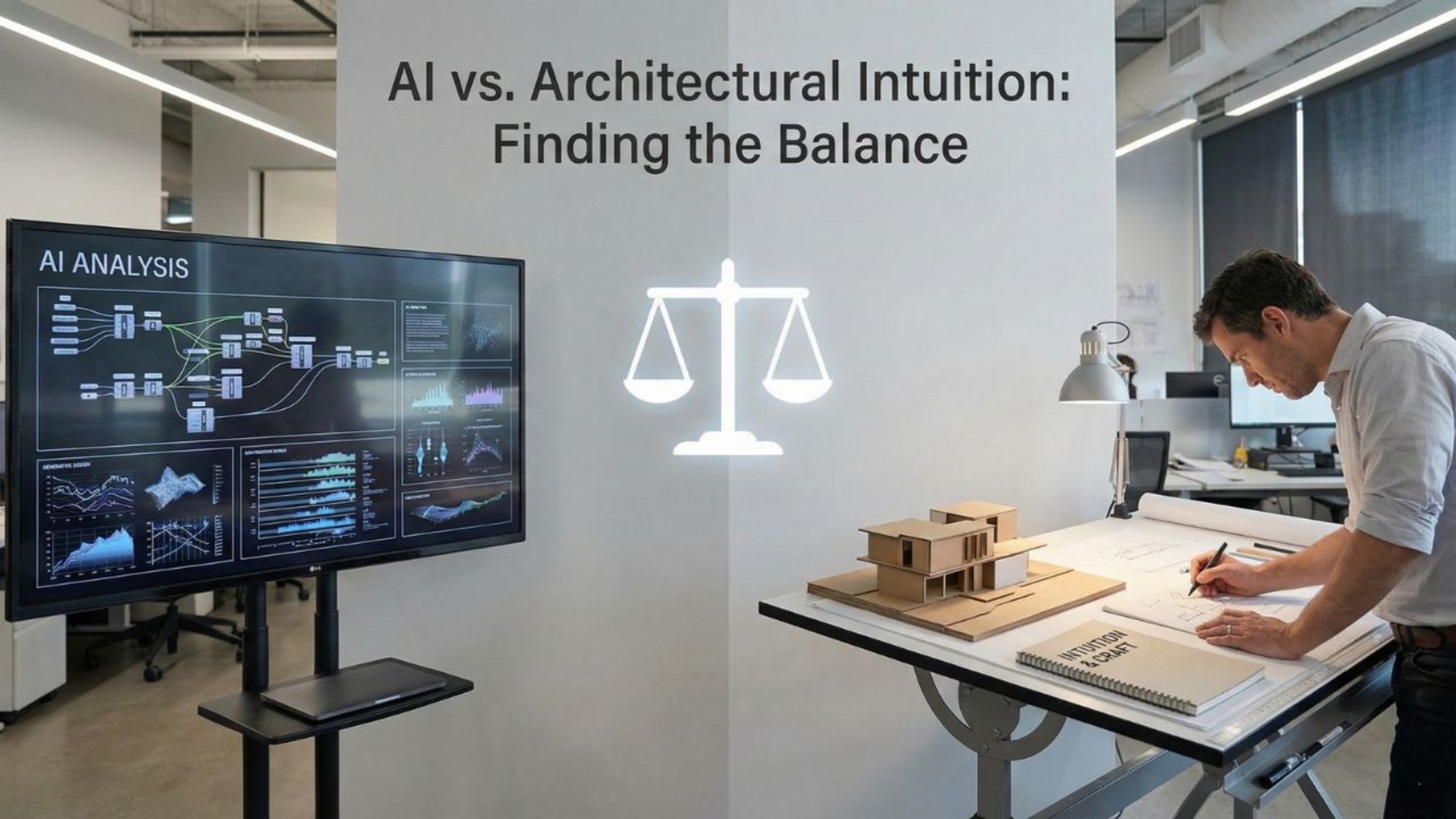
Artificial Intelligence vs. Architectural Intuition: Finding the Balance

There is a burgeoning anxiety vibrating through the studios of London and the design hubs of Dubai. It surfaces whenever a new generative algorithm produces a complex facade in seconds or an AI-driven script optimizes a floor plan for maximum yield. For the Principal who has spent decades honing their “architectural intuition”—that soul-deep understanding of proportion, light, and the “spatial narrative”—these developments can feel less like progress and more like an erasure of the craft.

The fear is that we are trading the “haptic soul” of a building for the cold efficiency of an algorithm. But as we navigate 2026, the most successful firms are discovering that the “Business of Awe” does not require a choice between human genius and machine speed. It requires a new synthesis: Digital Classicism fueled by a partnership between the gut and the grid.

The Dilemma: The Hallucination of Efficiency

The dilemma facing the modern firm owner is the seductive trap of “automated aesthetics.” AI can generate a thousand iterations of a tower in the time it takes an architect to sketch a single section. However, AI lacks a critical human faculty: Phenomenological Intent.

An algorithm can optimize for sun path or structural efficiency, but it cannot understand the feeling of a threshold. It doesn’t know why a specific shadow falling across a limestone floor at 3:00 PM creates a sense of sanctuary. When firms lean too heavily on AI-driven output without the filter of human intuition, the result is often “architectural uncanny valley”—spaces that look technically perfect but feel emotionally hollow. For the elite client, this hollow-ness is a dealbreaker. They are not paying for an optimized box; they are paying for a legacy-defining experience.

The Analysis: AI as the “Infinite Intern”

To find the balance, we must redefine the role of Artificial Intelligence. It is not the architect; it is the “Infinite Intern.” It is a tool for the heavy lifting of data synthesis, allowing the Principal to remain focused on the “digital craftsmanship” that matters.

In the framework of Digital Classicism, the balance is struck through a process of Curated Co-Creation:

  1. Iterative Breadth vs. Qualitative Depth: Use AI to explore the vast “latent space” of possibility—massing studies, material combinations, and structural permutations. Let the machine provide the breadth, while the human provides the depth of selection.
  2. The “Gut Check” as a Filter: Architectural intuition is essentially high-speed pattern recognition built on years of experience. The role of the Principal shifts from generating every line to editing the machine’s output with an authoritative “gut check.” Does this proportion feel human? Does this flow respect the ritual of the inhabitant?
  3. Data-Informed, Not Data-Driven: We use AI to provide the “Return on Design” data—energy performance, cost-of-build, and spatial efficiency. But we allow intuition to override the data when the “phenomenology of space” demands it. Sometimes, the most beautiful, human moment in a building is the most “inefficient” one.

The Strategy: Engineering the Hybrid Studio

For the firm owner, the goal is to build a studio culture where technology amplifies intuition rather than replacing it.

  • Codify Your Intuition: Create internal AI models trained on your firm’s unique “design DNA.” By feeding an AI your past successful projects, you aren’t automating your job; you are creating a digital mirror of your intuition that can help your team work faster within your established standards.
  • The Human-in-the-Loop Workflow: Ensure that every AI-generated asset is subjected to a “Haptic Review.” Before a client sees a render, it must be vetted for its emotional resonance and material honesty.
  • Focus on the “Small Data” of Experience: While AI excels at “Big Data” (yield, climate, structure), lean into the “Small Data” of human experience. Use immersive tech to walk through AI-generated spaces and adjust the “feel” in real-time.

The Bizwity Perspective: The Technology of Human Touch

At Bizwity, we view the rise of AI not as a threat to the architect, but as the ultimate liberation of the Designer. By offloading the mechanical and the repetitive to intelligent systems, you are finally free to return to the drafting table—digital or physical—to focus on the “Business of Awe.”

We help firms bridge the gap between algorithmic speed and architectural soul. Through immersive storytelling and high-fidelity digital twins, we allow you to take the raw output of AI and refine it through the lens of human intuition. The machine provides the options; you provide the soul. In the end, the most powerful AI in any project is still the one sitting between the Principal’s ears.