Thumbnails for showcase (9)

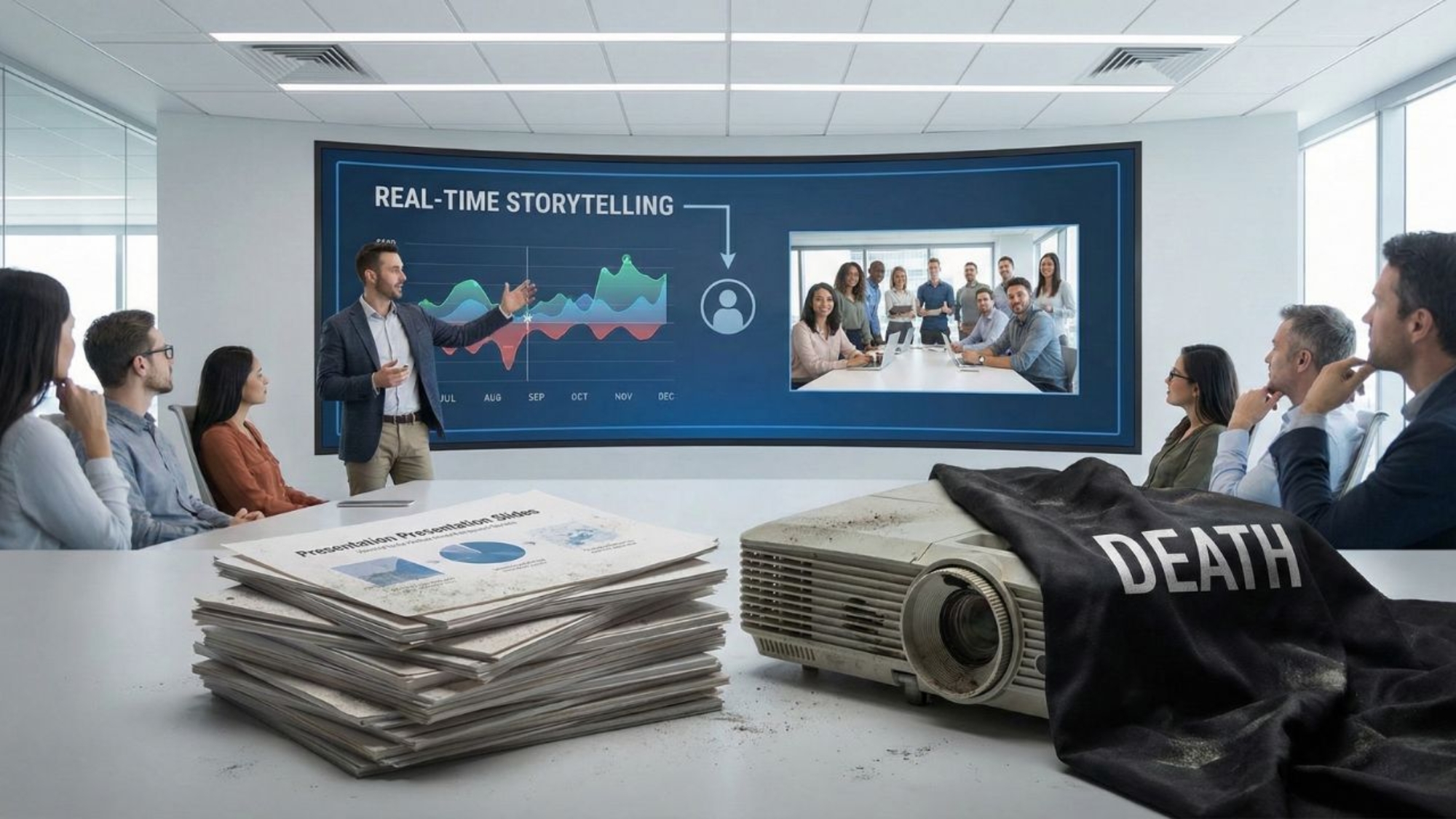
The Death of the Presentation Deck: A Case for Real-Time Storytelling

There is an exquisite irony at the heart of the modern high-end architectural practice. We design dynamic, four-dimensional spaces meant to evoke complex physiological and emotional responses—the “phenomenology of space.” Yet, when the defining moment arrives to secure the nine-figure commission to build that reality, we crush it flat. We reduce the soaring atrium and the tactile nuance of stone into a two-dimensional, linear PDF, and then proceed to read bullet points to a billionaire.

The presentation deck is not just an outdated legacy tool; it is an active saboteur of spatial awe. For the Principals of elite firms in London and Dubai, clinging to the slide deck is a strategic failure to align the sophistication of your sales process with the sophistication of your design product.

The Dilemma: The Straitjacket of Linearity

The fundamental flaw of the slide deck is its inherent rigidity. It forces a complex “spatial narrative” into a chronological straitjacket. You, as the presenter, dictate a forced march: first the site plan, then the massing diagram, then the lobby render, and finally, the penthouse view.

But high-level clients—sophisticated institutional investors or private patrons—do not think linearly. They think exploratively and skeptically.

The crisis occurs when a client interrupts slide ten to ask a critical question about a sightline relevant to slide thirty. The narrative spell is instantly broken. You are forced to stop, fumble out of presentation mode, scroll frantically past your carefully curated sequence, and apologize for the delay. In that moment, the Principal is demoted from a visionary guide to a flustered IT administrator. The deck cannot pivot, and therefore, it cannot persuade in real-time. It turns a dynamic consultation into a static lecture.

The Analysis: The Pivot to Real-Time Responsiveness

The future of elite presentation is not a better slide; it is a live simulation. We are entering the era of Real-Time Storytelling, powered by the same game engine technology (such as Unreal Engine 5) that drives the world’s most immersive entertainment.

This is the technological backbone of Digital Classicism—using advanced tools not for futuristic gimmickry, but to restore the ancient human desire for exploration and tactile discovery.

Shifting from a “deck” to a “real-time environment” fundamentally alters the power dynamic of the room:

  1. From Broadcasting to Navigating: Instead of flipping slides, the Principal stands inside a fully rendered, live digital twin. The presentation becomes a guided tour. If the client asks, “What does the light look like in the winter?” you don’t promise to send a render next week; you change the time of day and season instantly, right before their eyes.
  2. The Authority of Instant Data: Real-time allows for layering. You can move from a photorealistic view of a marble facade to an x-ray view of the structural steel mesh underneath with a single click. This demonstrates absolute command over the project’s data and “digital craftsmanship.”
  3. The Collaborative “Yes, And…”: When a client suggests an alteration in a real-time environment, you can often explore the implications immediately. The meeting shifts from a defense of a fixed idea to a collaborative co-authoring of the vision.

The Bizwity Perspective: Unleashing Intuition

At Bizwity, we recognize that the greatest asset a Principal brings to a high-stakes meeting is not the render, but their own intuition—their ability to “read the room” and pivot the narrative based on the client’s subtle reactions. The rigid slide deck handcuffs that intuition. Real-time storytelling unleashes it.

By adopting real-time tools, you are removing the friction between your vision and the client’s perception. You are no longer asking them to do the cognitive heavy lifting of imagining the future based on flat abstraction; you are inviting them to step inside it. In the “Business of Awe,” the firm that controls the reality of the meeting controls the outcome. The deck is dead; long live the experience.

Thumbnails for showcase (8)

How to Turn Your Website into a “Digital Sales Agent” That Never Sleeps

For most elite architecture and interior design firms, the website is a static digital mausoleum. It is a collection of high-resolution images of past projects, a list of awards, and an “About” page that speaks in the third person. It is beautiful, but it is silent. While the Principal is asleep in London or at a site visit in Dubai, the website sits passively, waiting for a prospect to do the heavy lifting of imagining their future project.

The dilemma for the modern Founder is that your website is likely your most underutilized asset. In an era where the “Business of Awe” is increasingly global and hyper-speed, a portfolio that just “shows” work is a liability. You need an asset that sells—one that filters prospects, builds intellectual authority, and provides a spatial experience 24/7. It is time to move from the digital brochure to the “Digital Sales Agent.”

The Dilemma: The Passive Portfolio Trap

The traditional architectural website suffers from what we call “The Passive Portfolio Trap.” It assumes that if the photography is stunning enough, the client will reach out. But high-net-worth (HNW) clients and institutional boards are looking for more than a lookbook; they are looking for a partner who can manage risk and deliver a specific “spatial narrative.”

When a potential client lands on a static site, they are met with a wall of completed work. There is no guidance, no interactive engagement, and no demonstration of the firm’s specific “digital craftsmanship.” This lack of interaction creates a “Conversion Gap.” The prospect leaves with a vague sense of your aesthetic but no understanding of your methodology or the ROI on your design. In the high-stakes world of elite commissions, a “vague sense” is a missed opportunity.

The Analysis: The Architecture of an Active Agent

To transform your site into a Digital Sales Agent, it must be architected with the same rigor you apply to a physical structure. It must move from a display of output to an invitation into a process.

A Digital Sales Agent performs three critical functions that a static portfolio cannot:

  1. Automated Authority Building: Instead of a generic contact form, the site offers “Intellectual IP”—white papers on urbanism, video deep-dives into material sourcing, or interactive guides to “experiential luxury.” It educates the client while the Principal is elsewhere, establishing the firm as the inevitable choice.
  2. Qualitative Nurturing: Through interactive elements, the site can “interview” the prospect. By the time they hit “Submit,” the site has already identified their project scope, aesthetic preferences, and timeline. This filters out “tire-kickers” and ensures the Principal only spends time on high-value leads.
  3. Immersive Pre-Visualization: In the spirit of Digital Classicism, the site should offer “Micro-Immersions.” These aren’t just galleries; they are web-based, interactive vignettes where a client can manipulate light or materials in a digital twin environment. It provides a taste of the “awe” they will receive if they hire the firm.

The Strategy: Engineering the 24/7 Conversion Engine

Turning your website into a high-performing agent requires a shift in digital strategy from decoration to utility.

  • The “Spatial Narrative” Lead Magnet: Offer a high-value digital asset in exchange for an email. Perhaps it’s “The 2026 Guide to Super-Prime Interiors in the UAE.” This captures the interest of clients who are in the “dreaming” phase but aren’t yet ready for a call.
  • Video as a Proxy for Presence: Use high-fidelity, cinematic video of the Founder explaining the why behind a specific project detail. This builds a parasocial bond, making the client feel they have already met the Principal before the first Zoom call.
  • The Interactive Fee Estimator (The Visioning Tool): While you shouldn’t list a price menu, you can offer a “Project Visioning Tool.” This allows prospects to select desired outcomes (e.g., “Atmospheric Wellness,” “Heritage Integration”) and receive a high-level strategic brief. It shifts the conversation from cost to value immediately.

The Bizwity Perspective: Scaling Your Expertise

At Bizwity, we recognize that a Principal’s time is the firm’s most limited resource. You cannot be in every initial screening call, yet your personal authority is the firm’s strongest selling point.

We help firms bridge this gap by treating the digital interface as a high-end concierge. By integrating immersive technology and strategic content automation, we turn your website into a tireless extension of your design philosophy. It doesn’t just show the “soul” of your work; it advocates for it. In the “Business of Awe,” your website shouldn’t just be a destination; it should be the most efficient closer on your payroll.

Gemini_Generated_Image_4w0zuk4w0zuk4w0z

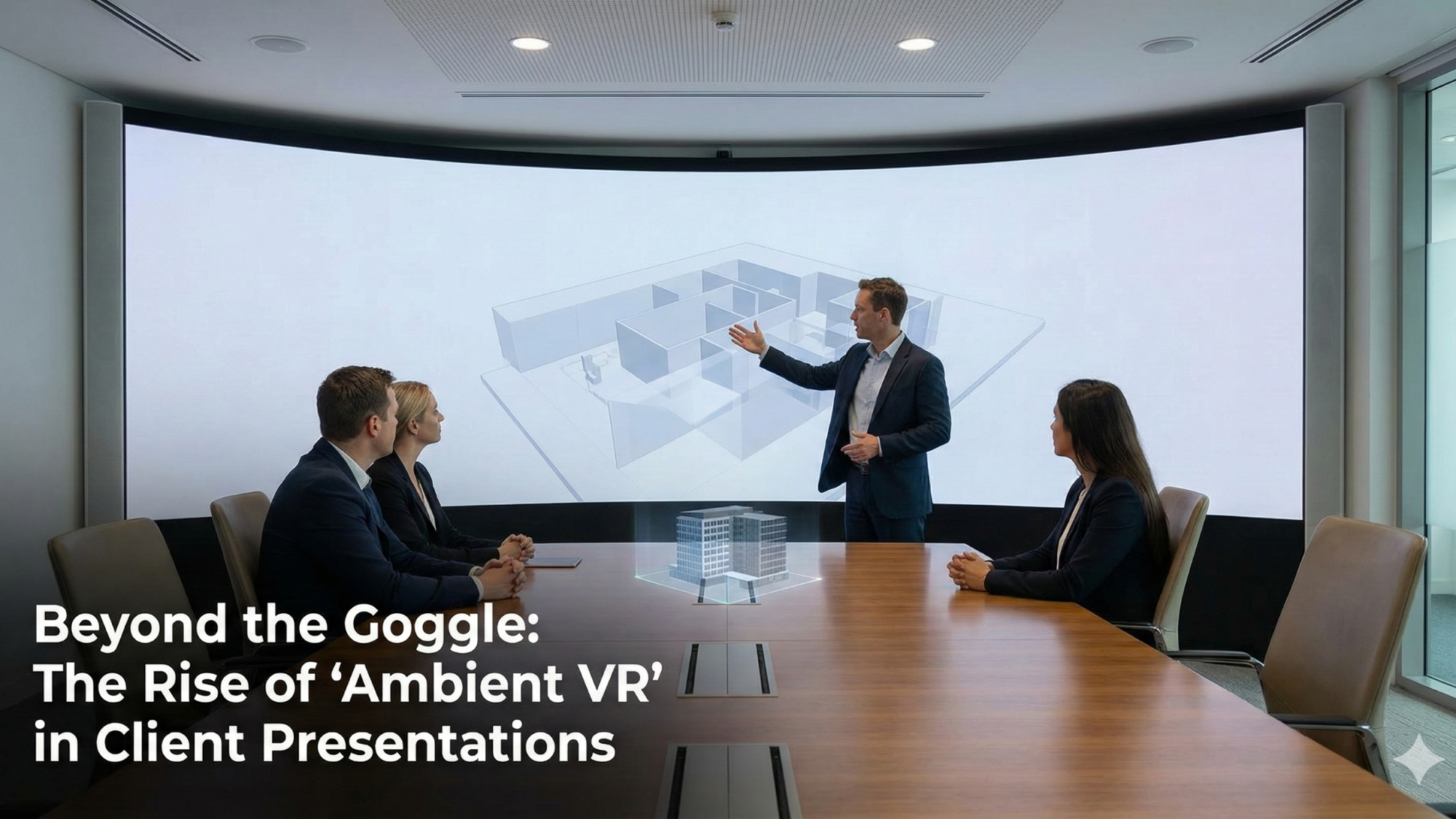
Beyond the Goggle: The Rise of “Ambient VR” in Client Presentations

There is a specific type of friction that has become all too common in high-stakes architectural presentations. You are in a boardroom in Mayfair or a private majlis in Dubai, about to unveil a nine-figure concept. You ask your UHNW client—a person whose time is valued in the thousands per minute—to strap a piece of plastic hardware to their face, effectively blinding them to the room and severing eye contact with you.

For a fleeting moment, they are wowed by the immersion. But the social dynamic of the meeting has collapsed. You are no longer a trusted advisor engaged in a dialogue; you are an IT technician narrating an isolated experience from the sidelines.

The dilemma for the modern Principal is that while Virtual Reality is the most powerful tool we have for conveying “spatial narrative,” its current delivery mechanism—the headset—is inherently anti-social. In the world of elite luxury, where trust is built on nuanced human connection, the “goggle” has become a barrier to sophistication.

The Dilemma: The Isolation of Immersion

Architecture is, by definition, a communal act. We design spaces for gathering, interaction, and shared experience. Yet, the prevailing method of presenting these spaces is profoundly solitary.

When a client puts on a headset, the “empathy loop” is broken. You cannot read their micro-expressions as they enter the digital atrium. You cannot gauge their posture as they experience the scale of the master suite. You are left guessing, watching a 2D relay screen while they experience a 3D reality alone.

This isolation degrades the presentation from a strategic consultation into a “tech demo.” For firms championing Digital Classicism—the marriage of high-touch values with high-tech execution—this clumsy technological intervention is a failure of elegance. It prioritizes the digital output over the human outcome.

The Analysis: Entering the Era of Ambient VR

The industry is on the cusp of a necessary evolution: the move from isolated VR to Ambient VR.

Ambient VR liberates immersion from the wearable device. It moves the digital reality out of the headset and into the physical room. We are seeing leading firms invest in “Immersion Salons”—dedicated spaces within their studios utilizing CAVE (Cave Automatic Virtual Environment) systems, large-scale LED volumes, or advanced multi-projection mapping.

In an Ambient VR setting, the client, the Principal, and the design team stand together inside the digital twin. The benefits reframe the entire client relationship:

  1. Communal Discovery: Everyone in the room sees the same thing at the same time at a 1:1 scale. You can physically point to a reveal detail in a digital cornice and discuss it face-to-face. The presentation becomes a shared journey, not a solitary trip.
  2. The Return of Gravitas: Without the awkwardness of hardware, the focus returns to the architecture and the intellectual authority of the Principal. The technology becomes invisible, serving only to amplify the “phenomenology of space.”
  3. Collaborative Friction: True design progress happens in the friction of debate. Ambient VR allows a client to turn to their partner or board member and discuss a sightline while standing in it. This real-time, in-situ feedback loop is impossible when participants are isolated in headsets.

The Bizwity Perspective: Technology that Respects the Room

At Bizwity, we believe that the most sophisticated technology is the kind that knows when to get out of the way. The future of architectural presentation is not about deeper isolation; it is about deeper connection.

Ambient VR aligns perfectly with the ethos of a human-first future. It respects the sanctity of the client relationship by removing the physical barriers between you. It turns the digital model into a collaborative campfire that you gather around, rather than a solitary cave you send your client into.

For the elite firm, investing in Ambient VR is not just an equipment upgrade; it is a statement that you value the human dynamic of the presentation as highly as the digital fidelity of the model. It is the ultimate expression of high-tech hospitality.

Thumbnails for showcase (6)

Digital Classicism: Why the Future of Architecture is Human-First

Architecture, at its apex, is not an intellectual exercise; it is a physiological event. It is the sudden drop in temperature when you enter a stone vestibule in Rome, the acoustic embrace of a timber-framed library in Kyoto, or the way light tracks across a lime plaster wall in a contemporary desert villa. These moments of “haptic resonance” are why we do what we do. They are the soul of the craft, the enduring legacy that outlives the architect.

Yet, a dangerous schism has opened in the highest echelons of our profession. We have embraced a digital toolset of unprecedented power—from generative AI to hyper-complex BIM protocols—but in doing so, we have largely anaesthetized the presentation of our work. We are producing photorealistic imagery that is technically flawless yet emotionally inert.

The dilemma for the modern Principal in London or Dubai is clear: our tools have never been sharper, but our ability to convey the phenomenology of space—the very human essence of dwelling—is being blunted by the cold precision of code. We are data-rich, but feeling-poor.

The Analysis: Defining Digital Classicism

To reclaim the soul of design without abandoning the advantages of modernity, the industry must pivot toward a new paradigm: Digital Classicism.

Do not mistake this for an aesthetic nostalgia for cornices and columns. Rather, it is a philosophical retrieval of classical values—human proportion, material honesty, and the primacy of the inhabitant’s experience—applied through the lens of advanced technology. It is a rejection of the sterile “render farm” aesthetic in favor of a warmer, more tactile digital reality.

Digital Classicism rests on three pillars:

  1. The Integrity of Imperfection: A standard CGI render is usually sterile because it lacks the chaotic patina of reality. True luxury has grain. Digital Classicism uses tools like real-time ray tracing in Unreal Engine 5 not to achieve clinical perfection, but to reintroduce the “flaw” of authentic materials—the slight warp of hand-hewn oak, the calcification on aged bronze. It is digital craftsmanship dedicated to replicating the analog soul.
  2. Proportion over Parametrics: We have become seduced by forms that are mathematically possible but humanly alienating. Digital Classicism uses VR and immersive spaces to rigorously test design against the Vitruvian measure of the human body. It uses tech to ensure that a space feels right, not just that it stands up.
  3. The Slow Reveal: In an era of instant digital gratification, classical architecture understands pacing. Digital Classicism uses immersive storytelling to control the sequence of arrival and discovery within a project, allowing the client to experience the unfolding “spatial narrative” exactly as the architect intended, rather than clicking randomly through a static gallery.

The Bizwity Perspective: Technology as an Empathy Engine

At Bizwity, we argue that the ultimate role of technology is to make architecture more human, not less. If your technology stack is distancing you from the visceral reality of your materials and your clients’ emotions, it is failing.

We view immersive platforms not as mere visualization tools, but as empathy engines. The power of Digital Classicism is that it uses sophisticated code to make the technology disappear. When a client steps into a high-fidelity, immersive environment that honors material integrity and human scale, the abstraction of the blueprint dissolves. They are no longer judging geometry; they are experiencing atmosphere.

The future of elite architecture does not belong to the firms with the fastest computers or the most complex algorithms. It belongs to the firms that master this essential paradox: using the most advanced digital tools to facilitate the most profoundly human experiences.

Thumbnails for showcase (5)

Scaling the Boutique: How to Grow Without Losing Your “Founder’s Touch”

The “Boutique Paradox” is a phenomenon that haunts every ambitious Principal in Mayfair, Dubai, and beyond. It is the moment where the very thing that built your firm—your obsessive, granular involvement in every “spatial narrative” and material selection—becomes the primary bottleneck to its growth. You have reached a ceiling where the demand for your “Foundational Awe” exceeds your physical capacity to deliver it.

For many, the fear of “scaling up” is actually a fear of dilution. We have all seen the cautionary tales: once-vibrant boutique firms that grew into corporate factories, trading their “haptic soul” for high-volume mediocrity. But in 2026, scaling is no longer a choice between staying small or becoming soulless. It is about a strategic shift from manual oversight to digital stewardship.

The Dilemma: The Fragility of Intuition

The dilemma lies in the “Founder’s Touch” being treated as a magical, non-transferable gift. In most boutique firms, the design philosophy exists as an oral tradition. It is a series of intuitive “yes” or “no” moments in the studio that only the Founder can provide.

This creates a high-stakes fragility. When the Founder is the only person who can truly define the “phenomenology of space” for a project, the firm cannot scale; it can only work harder. This leads to burnout, delayed timelines, and a terrifying realization: you haven’t built a brand that outlives you; you’ve built a high-end job. To scale without losing your soul, you must stop being the player and start being the composer.

The Analysis: From Craft to Codification

Scaling a boutique firm requires the transition from “Implicit Knowledge” (what you know intuitively) to “Explicit Systems” (what your team can execute autonomously). This is the core tenet of Digital Classicism.

In a traditional boutique, the Founder acts as a “Human Filter.” Every detail passes through them. In a Scaled Boutique, the Founder acts as the “Systems Architect.” They design the frameworks—the intellectual and digital scaffolding—that allow a senior team to replicate the Founder’s standards without the Founder’s constant presence.

We are seeing a shift where elite firms are utilizing “Internal Design Platforms.” These are not rigid templates, but digital repositories of the firm’s specific design DNA. When you codify your approach to light, your preference for specific jointry details, or your philosophy on “experiential luxury,” you aren’t removing the human touch; you are amplifying it. You are giving your team the tools to think like you, rather than wait for you.

The Strategy: Engineering the “Founder-Lite” Workflow

To grow while maintaining your signature rigor, you must implement a strategy of “Curated Autonomy.”

  1. Define Your “Non-Negotiables”: Identify the 20% of design decisions that create 80% of the “Awe” in your work. These are your “Signature Moments.” You personally oversee these, but delegate the rest to a team trained in your codified design language.
  2. The “Director-Led” Pivot: Hire or promote for “Design Alignment.” Your senior directors should not just be technically proficient; they must be philosophical mirrors. Your job shifts from designing the building to designing the designers.
  3. Institutionalize the “Design Review”: Move from ad-hoc interruptions to a formal, high-impact review cycle. This allows you to maintain the “Founder’s Touch” at critical milestones without becoming a micro-manager of daily tasks.

The Bizwity Perspective: Scaling Immersion

At Bizwity, we believe that technology is the ultimate guardian of the Boutique’s soul. The greatest challenge in scaling is maintaining the quality of the “Spatial Narrative” across multiple projects simultaneously.

Through high-fidelity digital twins and immersive VR environments, we allow Founders to “walk through” and critique multiple projects in a single afternoon, regardless of where they are in the world. This is Digital Stewardship in action. You can spot a misaligned material or a failed spatial transition in an immersive environment in seconds—something that would take hours to find in 2D plans.

By utilizing immersive technology as your primary quality-control lens, you can scale your firm’s output while ensuring that every project, whether in London or Dubai, still bears the unmistakable, haptic mark of your “Founder’s Touch.”

Thumbnails for showcase (4)

The Psychology of High-Net-Worth Clients: Why They Demand Immersion

In the world of ultra-high-net-worth (UHNW) individuals—those navigating the boardrooms of the City of London or the private offices of Dubai—time is the only currency that cannot be devalued. For the Principals of elite architecture firms, the greatest mistake is assuming that these clients are buying a building. They are not. They are buying the resolution of a psychological tension: the gap between a complex, high-stakes aspiration and the fear of a costly, public failure.

When a client is prepared to invest £50 million in a residential estate or a commercial landmark, their decision-making process is governed by a specific set of cognitive biases. To win their trust, a static PDF or a 2D floor plan is no longer just “old-fashioned”—it is psychologically insufficient. In 2026, the demand for immersion isn’t a tech preference; it is a neurological requirement for certainty.

The Dilemma: The Abstract Anxiety of Scale

The dilemma for the modern architect is that as project complexity increases, the client’s ability to intuitively “read” the design decreases. UHNW clients are often visionaries in their own fields—finance, tech, or industry—but they are rarely trained in spatial visualization.

When you present a set of technical drawings or even a beautiful but static render, you are asking the client to perform an exhausting mental calculation. They must translate lines and shadows into a “spatial narrative.” This “cognitive load” creates a subtle but persistent friction. If the client cannot feel the volume of the grand hallway or the intimacy of the library, they default to their most primitive psychological defense: skepticism. They begin to obsess over small, manageable details—like the price of a fixture—because they cannot grasp the holistic value of the atmosphere. They aren’t being difficult; they are simply trying to find a footing in an abstract void.

The Analysis: Certainty, Status, and the “Pre-Occupancy” Effect

To understand why immersion is non-negotiable, we must look at the three psychological pillars of the UHNW decision-making process:

  1. The Erasure of Risk through Digital Twins: For a high-stakes client, “risk” isn’t just financial; it’s the social risk of a project that doesn’t “land.” High-fidelity digital twins provide what psychologists call “predictive validity.” When a client can walk through a digital version of their project that perfectly reflects the “digital craftsmanship”—down to the way light reflects off a specific grain of oak—the perceived risk drops to near zero.
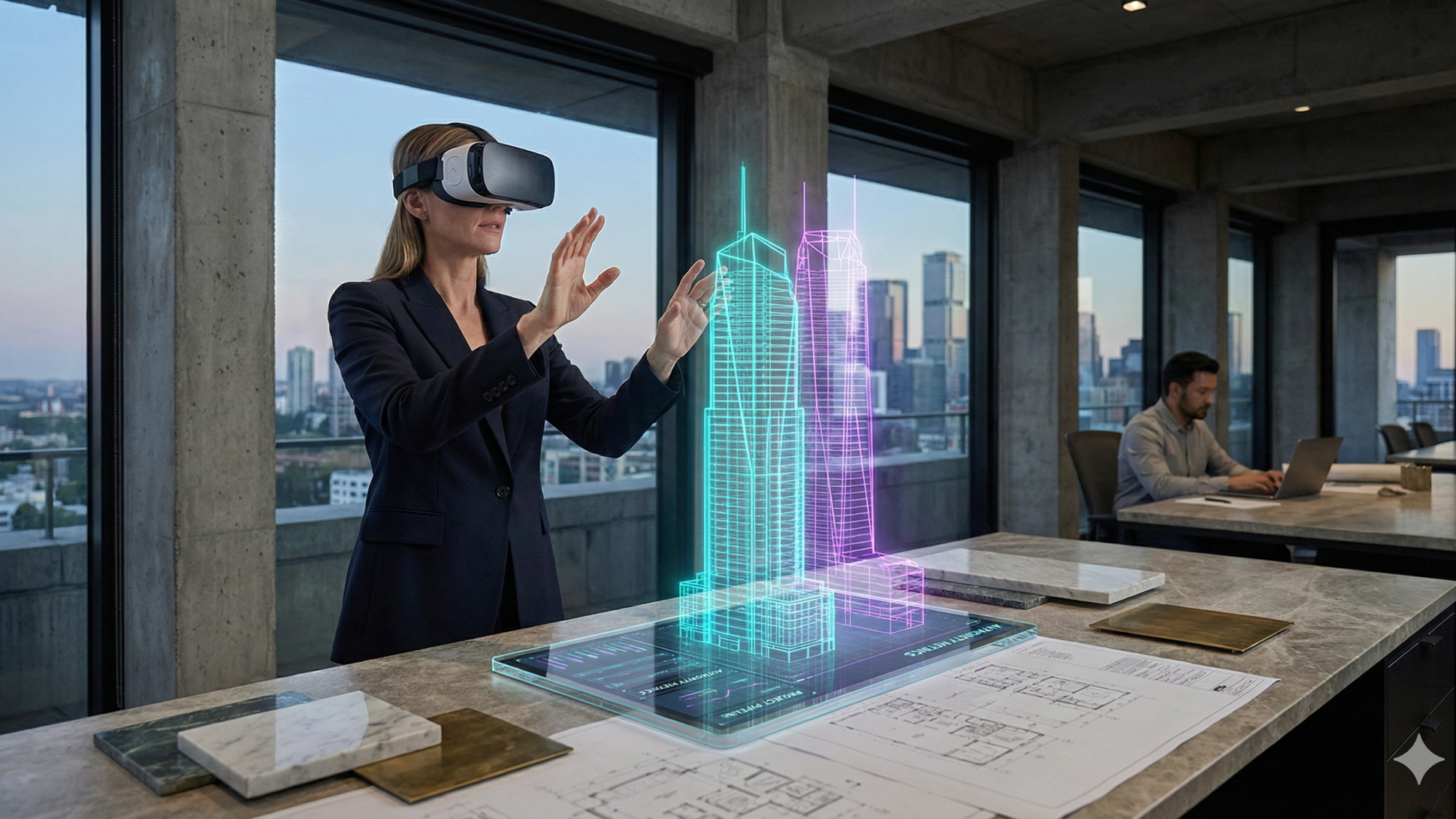
  2. The Ownership of Atmosphere: UHNW clients are motivated by “experiential luxury.” They want to know how the space will facilitate their lifestyle. Immersion allows for “emotional pre-occupancy.” If they can virtually stand at their future window at sunset, they have already mentally “moved in.” Once that emotional anchor is set, the contract is effectively signed.
  3. The Status of Sophistication: In elite circles, the process is a status symbol. Presenting a project via immersive VR or a holographic model signals that the architect is operating at the absolute peak of the industry. It aligns the client with innovation, reinforcing their identity as a forward-thinking patron of “Digital Classicism.”

The Strategy: Designing for Neurological Comfort

Bridging the gap between your vision and the client’s comfort requires a strategic shift in your presentation philosophy.

  • Move from “Explaining” to “Experiencing”: If you find yourself spending more than five minutes explaining a drawing, you have lost the psychological edge. Use immersive tools to let the client discover the space themselves. Discovery leads to a much stronger sense of ownership than explanation ever will.
  • The Haptic Digital Proxy: Ensure your digital assets prioritize “haptic feedback.” The textures should look so real the client reaches out to touch the screen. This satisfies the “phenomenology of space” and builds immediate, subconscious trust in your design rigor.
  • Narrative over Navigation: Don’t just give the client a “walkthrough” controller. Guide them through a “spatial narrative.” Show them the transition from the public grandiosity of the entrance to the private sanctuary of the master suite. Design the emotional journey of the reveal.

The Bizwity Perspective: Bridging the “Empathy Gap”

At Bizwity, we believe the most powerful tool an architect possesses is empathy. The Principals we work with understand that their job is to lead a client through a vulnerable process of creation.

By utilizing immersive technology, you aren’t just showing off high-tech tools; you are bridging the “empathy gap.” You are providing the client with the one thing their wealth cannot usually buy: total certainty about the future. When we help firms transition to immersive storytelling, we aren’t just helping them close deals; we are helping them build a “Business of Awe” that respects the psychological reality of their most important clients.

Thumbnails for showcase (3)

From Portfolio to Platform: How to Build a Brand That Outlives Its Founder

There is a quiet, existential crisis that visits every successful Principal of a founder-led firm. It usually arrives not during failure, but at the apex of success. You are looking at a retrospective monograph of your work, or perhaps standing in a critically acclaimed pavilion you designed in Dubai, and a chilling realization takes hold: if you stepped away tomorrow, this entire ecosystem—the vision, the client trust, the specific “phenomenology of space” that defines your output—would cease to exist.

You have built a brilliant practice. But you have not yet built a business.

For the elite architects and designers defining the skyline in 2026, the ultimate design challenge is not physical; it is organizational. It is the challenge of transmuting personal genius into institutional longevity. Moving from a “Portfolio”—a collection of past achievements reliant on a single author—to a “Platform”—a self-sustaining engine of design excellence—is the only path to securing true legacy.

The Dilemma: The “Cult of Personality” Trap

The architectural industry has historically fetishized the singular genius—the “starchitect” whose napkin sketch becomes dogma. While this builds incredible mystique in the short term, it creates a fragile enterprise in the long term.

The dilemma is deeply personal. Your firm’s reputation is likely inextricably tied to your own name, your specific handshake, and your intuitive grasp of “experiential luxury.” Your clients hire you, not your junior associates. This centralization of capability creates a bottleneck on growth and, critically, devalues the business as an asset. A practice dependent on the founder’s daily intervention is difficult to scale and nearly impossible to sell or pass down. The “soul” of the work is currently trapped in your own cognition.

The Analysis: Codifying Intuition into Institution

To build a platform, one must dissect what actually makes the firm successful beyond the founder’s presence. It requires moving from an oral tradition of design to a codified “design language.”

This is not about creating rigid templates that stifle creativity. It is about defining the philosophical guardrails within which your team can innovate. It is the difference between a “signature style” (which dies with the author) and a “house style” (which evolves with the institution).

In the era of “Digital Classicism,” we have better tools than ever to capture this. We must move beyond viewing the portfolio as a marketing asset and start viewing it as a repository of institutional memory. Why does that specific reveal detail work? How do we approach light in an arid climate versus a temperate one? If these answers only exist in the founder’s head, they are rented knowledge, not owned intellectual property.

The Strategy: Engineering Institutional DNA

Transitioning to a platform requires a deliberate shift in how intellectual capital is managed and deployed.

  1. Decentralize Client Intimacy: The most dangerous phrase in a firm is, “The client only wants to talk to me.” You must actively elevate your Principals and Directors into the spotlight. The client needs to trust the process and the team, not just the individual. The firm must own the relationship.
  2. The “Living” Design Bible: Move beyond static CAD standards. Create a dynamic, evolving internal resource that documents not just the what, but the why of your design decisions. This is about teaching the “feel” of your architecture—the intangible qualities that separate digital craftsmanship from mere construction.
  3. Ritualize critique: Establish rigorous design review processes where the founder’s role shifts from “creator” to “curator.” Your job is no longer to generate every idea, but to pressure-test the ideas of others against the established firm ethos.

The Bizwity Perspective: Immersive Knowledge Transfer

The hardest thing to transfer to the next generation of leadership is the intangible—the sensory intuition of space. This is where Bizwity sees technology playing a pivotal role in legacy building.

Immersive technology and digital twins are not just presentation tools; they are archiving tools. By creating high-fidelity immersive records of your best work, you are building a virtual academy for your staff. A junior architect in your London studio can step inside a project built in Riyadh five years ago, experiencing the scale and materiality exactly as you intended.

This is the ultimate goal of the platform: using “Digital Craftsmanship” to ensure that the founding vision becomes a teachable, repeatable, and evolvable standard. When your design philosophy can be experienced without you in the room, you have successfully moved from a portfolio to a platform.

Gemini_Generated_Image_4ephjd4ephjd4eph

The 2026 Architecture Fee Guide: Pricing for Experience, Not Hours

There is an inherent, almost insulting disconnect that occurs at the end of a landmark project. You have just delivered a sprawling penthouse overlooking Hyde Park or a culturally significant majlis in Dubai—spaces defined by exquisite materiality and complex structural narrative. Yet, the final conversation with the client is reduced to a pecuniary dissection of timesheets and hourly rates.

It is the industry’s oldest wound: the misalignment between the immense, enduring value of high-end architectural design and the archaic, industrial-era method we use to price it. For the Founders of elite firms, continuing to shackle your intellectual capital to the billable hour is not just bad business; it is a fundamental devaluation of your craft. As we look toward 2026, the market for ultra-prime design demands a radically different financial model—one based on the “experiential asset” you create, not the time it took you to conceive it.

The Dilemma: The Commoditization of Genius

The hourly billing model is a relic of a time when architecture was viewed primarily as a technical service rather than the creation of high-value intellectual property. When a firm bills by the hour, it implicitly tells the client: “We are selling you our labor.” In the luxury sector, this is a catastrophic positioning error.

Labor is a commodity; vision is scarce.

The dilemma facing sophisticated Principals today is that efficiency is punished. If your senior team, leveraging decades of experience and cutting-edge “Digital Craftsmanship,” solves a complex site constraint in four hours instead of forty, the hourly model dictates you should be paid less for that brilliance. This structure incentivizes bloated processes over elegant solutions and aligns your firm with contractors rather than consultants. In the boardrooms of Mayfair and DIFC, your clients do not buy hours; they buy certainty, status, and awe.

The Analysis: The Asymmetric Value Proposition

The shift required for 2026 is recognizing the asymmetry between your input costs and the client’s outcome value. A well-executed architectural intervention does not just house a client; it significantly enhances their quality of life, optimizes their business operations, or vastly increases the asset value of their property portfolio.

In the current experiential economy, architecture is the ultimate luxury good. The “phenomenology of space”—how a room feels, the way light dictates mood, the tactile response of materials—is where the true value lies. These are intangible deliverables that cannot be measured by a stopwatch.

When firms stick to hourly billing, they fail to capture the value of this “experiential equity.” They remain trapped in a transactional relationship, constantly defending their time, rather than evolving into a strategic partnership focused on maximizing the project’s potential.

The Strategy: Decoupling Time from Revenue

Transitioning to an experience-based pricing model is to move from being a vendor to being a partner. It requires confidence and a restructuring of how you articulate value.

  1. Productize the “Visioning Phase”: Stop giving away your best ideas in free pitch meetings. Create a standalone, fixed-fee “Visioning Package.” This is a high-value, low-risk entry point for the client where you deliver initial concepts, site analysis, and strategic direction. It establishes authority and gets paid for high-level intellectual property upfront.
  2. Value-Based Phasing: Instead of generic RIBA stages linked to hours, define phases by experiential outcomes. A “Spatial Narrative Definition” phase carries a higher fixed value than a “Construction Documentation” phase, reflecting the higher density of creative intellect required.
  3. The “Certainty Premium”: High-net-worth clients will pay a premium for reduced risk. Frame fixed-fee structures not as a cost savings, but as a guarantee of delivery without the volatility of hourly overruns. You are selling price certainty alongside design excellence.

The Bizwity Perspective: Immersive Validation

The most significant barrier to value-based pricing has always been the client’s inability to visualize the outcome before signing the contract. This is where “Digital Classicism” becomes a financial tool.

At Bizwity, we see immersive technology as the validator of high fees. When you can place a client inside a hyper-realistic digital twin of their future project during the proposal phase, the conversation shifts immediately. They are no longer buying promises; they are experiencing the future reality.

Immersive portfolios and VR walkthroughs provide the “haptic proof” of your concept. When a client has already emotionally connected with the space through immersion, the fee becomes secondary to acquiring that experience. Technology allows you to front-load the “awe,” making the transition from hourly haggling to value-based partnership not only possible but inevitable.

Gemini_Generated_Image_2hu7rk2hu7rk2hu7

Why Your Firm’s “Authority Gap” is Costing You Seven-Figure Commissions

There is a specific, hollow feeling known only to the Principals of highly capable, creatively rigorous architecture firms. It arrives when you see the shortlist for a landmark cultural project in London or a super-prime development on the Palm Jumeirah, and your firm isn’t on it. Instead, you see the usual suspects: the “starchitect” brands that haven’t innovated in a decade, or the commercial giants known for volume over nuance.

You know your team has the technical prowess and the design sensibility to execute the project better. Yet, the invitation never came. This isn’t a failure of talent; it is a failure of perception. You are suffering from an “Authority Gap”—the expensive chasm between the caliber of work you are capable of delivering and the market’s awareness of that capability. In the realm of eight- and nine-figure project values, this gap is where seven-figure commissions go to die.

The Dilemma: The Failure of Static Credentials

For decades, the architectural industry relied on a polite system of credentials: a glossy monograph, a curated portfolio of finished photography, and word-of-mouth within elite circles. In today’s hyper-accelerated, globalised market, these static indicators are insufficient.

The dilemma for the principled Founder is that while you are busy perfecting the “phenomenology of space” and ensuring the integrity of your materials, your louder competitors are busy manufacturing authority. When a high-net-worth individual or an institutional board is preparing to deploy hundreds of millions in capital, their primary motivator is not aesthetics; it is risk mitigation. A static website featuring beautiful, silent images of past work does not sufficiently de-risk the future. It shows what you did, but it fails to authoritatively communicate how you think and why you are the inevitable choice for their specific, complex challenge.

The Analysis: The Anatomy of Asymmetry

The Authority Gap is a form of information asymmetry. You possess deep “intellectual capital”—the complex problem-solving methodologies and unique design philosophies that define your practice—but the market only sees the superficial output.

In elite markets like Dubai and London, authority is no longer just about accumulated legacy; it is about “demonstrable foresight.” Clients are seeking partners who can navigate complex regulatory environments, integrate emerging technologies, and guarantee an experiential outcome. When your firm relies on traditional, passive marketing, you are effectively asking these high-stakes clients to take a leap of faith based on 2D evidence.

The gap widens when competitors utilize “Digital Classicism”—marrying timeless design principles with cutting-edge digital execution—to present a more sophisticated front. If your presentation feels analogue in a digital world, your authority is implicitly diminished. You begin to look like a risk, rather than a safe pair of hands.

The Strategy: Bridging the Void with Intellectual IP

Closing the Authority Gap requires a pivot from passive portfolio display to active intellectual dominance. You must stop waiting to be discovered and start engineering your authority.

  1. Publish Your Methodology, Not Just Your Results: Don’t just show the finished opera house. Publish a white paper on the acoustic engineering challenges or the urban integration strategy. Turn your internal processes into external intellectual property. This demonstrates rigor before the RFI is even issued.
  2. Curate Exclusion: Authority is derived as much by what you refuse as what you accept. Be publicly clear about the type of client profile and project scope you serve. Specialization breeds authority; generalism dilutes it.
  3. The “Process as Product” Shift: In a saturated market, your unique process is a key differentiator. How do you move from sketch to BIM to reality? Demystifying your complex workflow doesn’t give away secrets; it proves competence to clients who value engineered precision.

The Bizwity Perspective: Immersive Tech as the Ultimate Authority Signal

At Bizwity, we observe that the most successful firms are using immersive technology not just as a visualization tool, but as the ultimate bridge for the Authority Gap.

When you present a concept using high-fidelity, immersive storytelling—allowing a client to step inside a “digital twin” that is rich with data, materiality, and atmosphere—you are doing more than selling a design. You are demonstrating absolute command over the contemporary tools of your trade. You are signaling that your firm operates at the bleeding edge of “Digital Craftsmanship.”

An immersive portfolio removes ambiguity. It takes the abstract “intellectual capital” of your firm and renders it as a tangible, irrefutable experience. In the high-stakes arena of global architecture, the firm that can provide the most immersive certainty is the firm that commands the highest authority—and the commissions that come with it.

2

The “Silent” Sale: How Immersive Portfolios Close Deals Before the First Meeting

There is a singular, quiet moment that every Principal lives for: that split second during a presentation when a client’s posture shifts, their eyes widen, and the air in the room changes. It is the moment the “spatial narrative” finally clicks—the transition from looking at a blueprint to feeling a home. For years, we have chased this moment in boardrooms in Mayfair or high-rises in Dubai, armed with heavy physical samples and oversized leather-bound portfolios. But in an era of hyper-compressed schedules and global competition, waiting for the physical meeting to spark that connection is a strategic gamble you can no longer afford to take.

The Dilemma: The Static Glass Ceiling

The traditional architectural portfolio is currently hitting a glass ceiling. While a high-gloss PDF or a curated Instagram grid can showcase the aesthetic of a firm, they are fundamentally incapable of conveying the soul of the work. Static imagery creates a distance; it invites the client to judge a project as a 2D composition rather than an inhabited experience.

For the Principals of elite firms, this creates a frustrating friction. You spend hundreds of hours perfecting the “phenomenology of space”—the way light hits a fluted marble column at dusk, or the haptic satisfaction of a heavy timber door—only to have that sensory depth flattened into a 1MB thumbnail. When your primary business development tool is a static document, you aren’t selling an experience; you are selling a gallery. This failure of medium forces you to spend the first three meetings “defending” your vision rather than expanding it.

The Analysis: The Cognitive Shift to Digital Craftsmanship

The “Business of Awe” relies on a cognitive principle: certainty drives investment. Elite clients in London and the UAE are not just buying a design; they are buying the confidence that their future reality will match their current aspiration.

We are seeing a move toward Digital Classicism—a philosophy where the rigor of traditional architectural principles is enhanced, not replaced, by digital mastery. An immersive portfolio is the pinnacle of this movement. It moves beyond the “walkthrough” and into the realm of experiential luxury.

When a portfolio is built on immersive storytelling, it addresses the client’s subconscious needs:

  • Volumetric Understanding: The client understands the scale of a double-height atrium intuitively, without needing to “read” a section drawing.
  • Material Honesty: Digital craftsmanship now allows for the rendering of “imperfect” textures—the grain of oak, the patina of brass—which signals a level of design sophistication that “perfect” CGI lacks.
  • Emotional Pre-Occupancy: By the time the client walks into your office, they have already “lived” in the space. The sale has happened in silence, across a digital interface, long before the first handshake.

The Strategy: Engineering the “Pre-Meeting” Win

To move your firm toward a “Silent Sale” model, the strategy must shift from showing to submerging.

  1. Audit Your Friction Points: Look at your current lead-nurturing process. If you are sending a standard PDF deck to a high-net-worth prospect, you are asking them to do the emotional heavy lifting of imagining your work. Replace one static case study with a high-fidelity, interactive “Spatial Narrative.”
  2. Focus on the “Micro-Moment”: Don’t just show the whole building. Create an immersive vignette of a single, powerful detail—a library corner or a gallery transition. This demonstrates your obsession with the “haptic feedback” of design.
  3. The Authority of the “Digital Twin”: Position your immersive assets not as “marketing,” but as “pre-construction truth.” This frames your tech stack as a tool for precision and design excellence, not just a flashy presentation.

The Bizwity Perspective: The Human Connection to Code

At Bizwity, we recognize that the greatest challenge for a Founder is the paradox of time: you want to be at the drafting table, but you are often trapped in the “sales funnel.”

We view immersive technology not as a replacement for the human touch, but as its most powerful conduit. By bridging the gap between neoclassical design philosophy and cutting-edge digital storytelling, we allow your work to speak for itself. An immersive portfolio doesn’t just display your past projects; it creates a shared reality between you and your client. It removes the guesswork, silences the skepticism, and allows the “Awe” of your design to perform the heavy lifting of business development for you.