There is a specific type of friction that has become all too common in high-stakes architectural presentations. You are in a boardroom in Mayfair or a private majlis in Dubai, about to unveil a nine-figure concept. You ask your UHNW client—a person whose time is valued in the thousands per minute—to strap a piece of plastic hardware to their face, effectively blinding them to the room and severing eye contact with you.
For a fleeting moment, they are wowed by the immersion. But the social dynamic of the meeting has collapsed. You are no longer a trusted advisor engaged in a dialogue; you are an IT technician narrating an isolated experience from the sidelines.
The dilemma for the modern Principal is that while Virtual Reality is the most powerful tool we have for conveying “spatial narrative,” its current delivery mechanism—the headset—is inherently anti-social. In the world of elite luxury, where trust is built on nuanced human connection, the “goggle” has become a barrier to sophistication.
The Dilemma: The Isolation of Immersion
Architecture is, by definition, a communal act. We design spaces for gathering, interaction, and shared experience. Yet, the prevailing method of presenting these spaces is profoundly solitary.
When a client puts on a headset, the “empathy loop” is broken. You cannot read their micro-expressions as they enter the digital atrium. You cannot gauge their posture as they experience the scale of the master suite. You are left guessing, watching a 2D relay screen while they experience a 3D reality alone.
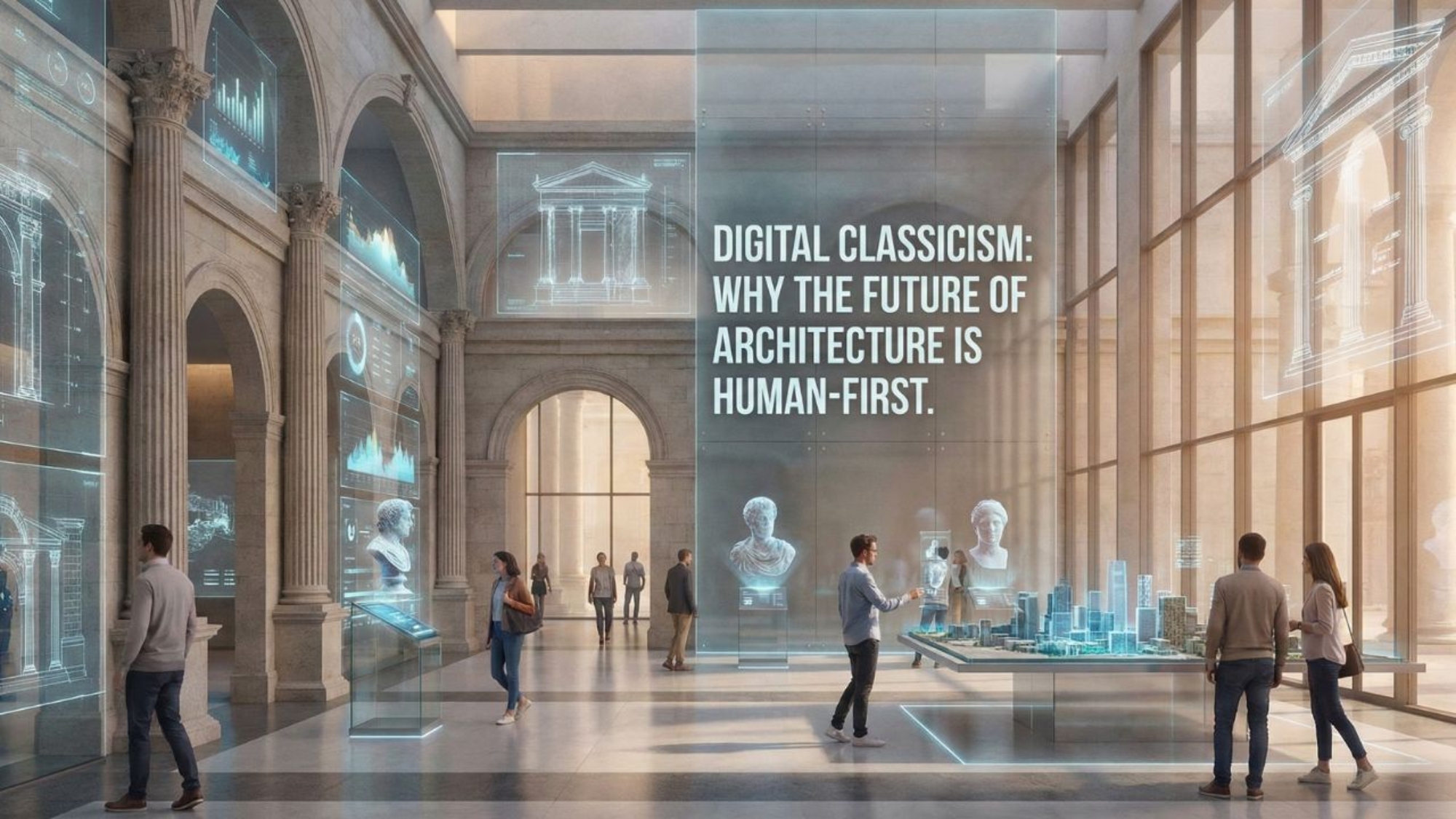
This isolation degrades the presentation from a strategic consultation into a “tech demo.” For firms championing Digital Classicism—the marriage of high-touch values with high-tech execution—this clumsy technological intervention is a failure of elegance. It prioritizes the digital output over the human outcome.
The Analysis: Entering the Era of Ambient VR
The industry is on the cusp of a necessary evolution: the move from isolated VR to Ambient VR.
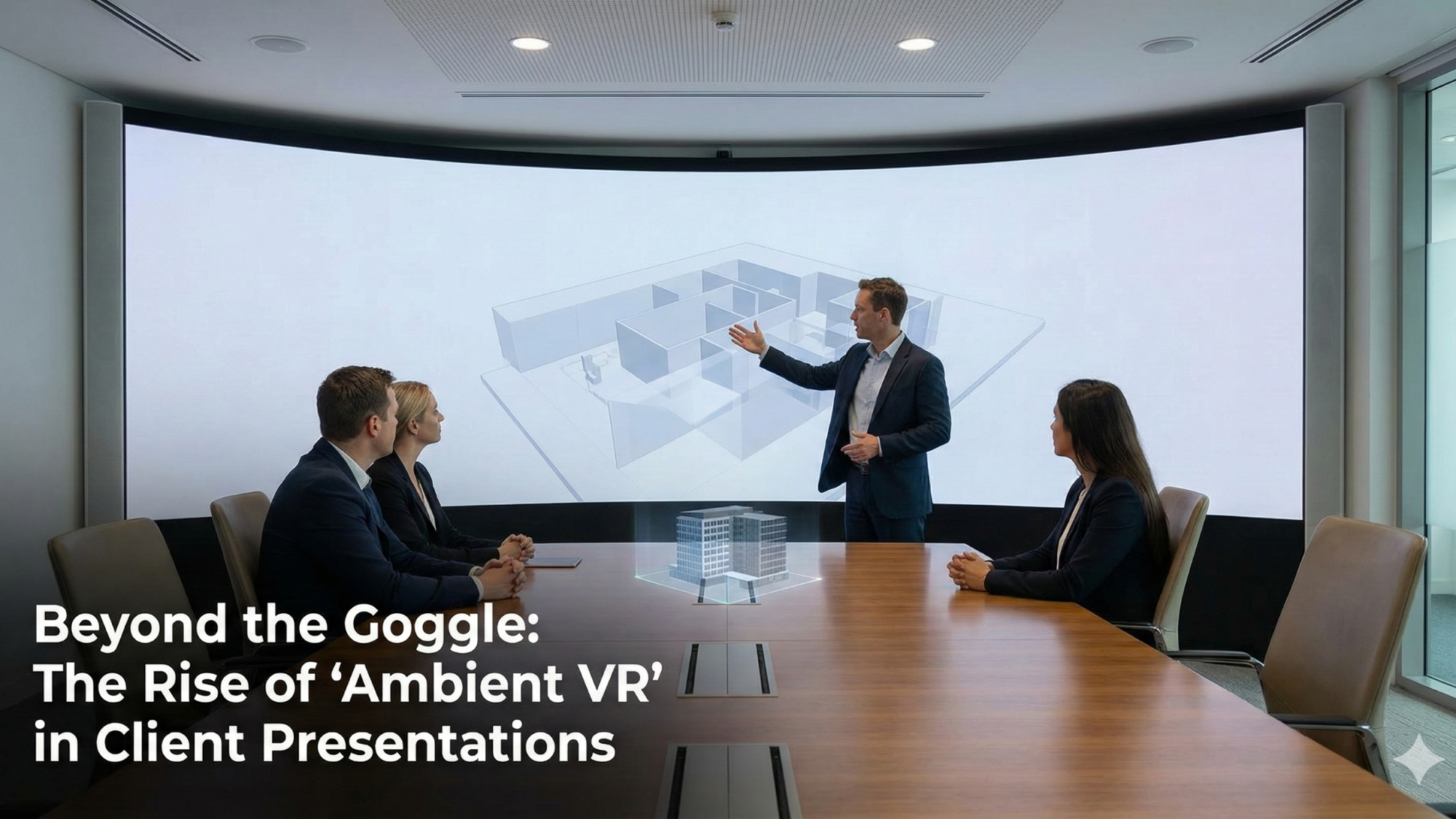
Ambient VR liberates immersion from the wearable device. It moves the digital reality out of the headset and into the physical room. We are seeing leading firms invest in “Immersion Salons”—dedicated spaces within their studios utilizing CAVE (Cave Automatic Virtual Environment) systems, large-scale LED volumes, or advanced multi-projection mapping.
In an Ambient VR setting, the client, the Principal, and the design team stand together inside the digital twin. The benefits reframe the entire client relationship:
- Communal Discovery: Everyone in the room sees the same thing at the same time at a 1:1 scale. You can physically point to a reveal detail in a digital cornice and discuss it face-to-face. The presentation becomes a shared journey, not a solitary trip.
- The Return of Gravitas: Without the awkwardness of hardware, the focus returns to the architecture and the intellectual authority of the Principal. The technology becomes invisible, serving only to amplify the “phenomenology of space.”
- Collaborative Friction: True design progress happens in the friction of debate. Ambient VR allows a client to turn to their partner or board member and discuss a sightline while standing in it. This real-time, in-situ feedback loop is impossible when participants are isolated in headsets.
The Bizwity Perspective: Technology that Respects the Room
At Bizwity, we believe that the most sophisticated technology is the kind that knows when to get out of the way. The future of architectural presentation is not about deeper isolation; it is about deeper connection.
Ambient VR aligns perfectly with the ethos of a human-first future. It respects the sanctity of the client relationship by removing the physical barriers between you. It turns the digital model into a collaborative campfire that you gather around, rather than a solitary cave you send your client into.
For the elite firm, investing in Ambient VR is not just an equipment upgrade; it is a statement that you value the human dynamic of the presentation as highly as the digital fidelity of the model. It is the ultimate expression of high-tech hospitality.